Ai.Rax Review: The All-in-One AI Content Detector for Cross-Media Verification
As AI generation tools become more accessible to users of all skill levels, the line between human-created and AI-generated content is increasingly blurred. For students, educators, content creators,…

As AI generation tools become more accessible to users of all skill levels, the line between human-created and AI-generated content is increasingly blurred. For students, educators, content creators, brand safety teams, and fact-checkers, verifying the origin of text, images, audio, and video is no longer a niche need—it’s a core part of daily work. Whether you’re looking to test an essay draft to remove AI detection from essay submissions, verify the authenticity of a viral social media video, or confirm that freelance content meets your quality standards, a reliable AI Content Detector is non-negotiable. In this review, we break down the capabilities of Ai.Rax, the multi-modal AI detection platform that delivers 96% accuracy across all content types, and explore how its industry-leading Synthetic Media Detection tools solve real-world pain points for users across industries.
How AI Content Detection Works: Technical Principles for Every Media Type
Many users only associate AI detection with text analysis, but modern AI generation tools can create every type of media imaginable, from photorealistic images to cloned audio of public figures. Effective detection requires specialized models tailored to the unique fingerprints AI generators leave in each content format. Below, we break down how detection works for each media type, with concrete examples of how Ai.Rax identifies synthetic content.
Text Detection
All large language models (LLMs) generate text based on statistical patterns learned from billions of pages of training data. This process leaves consistent, measurable fingerprints that AI detectors pick up, even in paraphrased or lightly edited content. The two core metrics text detectors use are:
-
Perplexity: A measure of how unpredictable the sequence of words in a text is. Human writers tend to use more unusual phrasing, personal asides, and idiosyncratic word choices, leading to higher perplexity scores. AI-generated text is far more predictable, with common, low-variance phrasing that leads to lower perplexity.
-
Burstiness: A measure of variation in sentence length and structure. Human writers naturally mix short, punchy sentences with longer, more complex ones, while AI-generated text tends to have far more uniform sentence structure across a piece of content.
For example, a student who uses an LLM to draft a first version of a biology essay on bee population decline will likely end up with a draft that has consistent 18-22 word sentences, generic phrasing like “Bee population decline is a critical environmental issue that threatens global food security,” and no personal anecdotes or unique observations. When run through Ai.Rax’s text detection model, this draft will be flagged as AI-generated. The student can then rewrite flagged sections to include personal observations from a high school science project tracking local bee populations, varied sentence structure, and unique phrasing. Testing the revised draft through Ai.Rax lets the student refine their work to remove AI detection from essay submissions, avoiding unfair academic penalties while retaining the core research they included in their draft. Ai.Rax’s text model is trained on millions of text samples across 50+ languages and every academic level, genre, and industry, leading to extremely low false positive rates that avoid flagging well-written human content as AI.
Image Detection
AI image generators create visual content by mapping text prompts to latent space patterns learned from millions of training images. This process leaves unique artifacts that are often invisible to the untrained eye, but easily picked up by advanced detection models. Ai.Rax’s image detection scans for three core markers:
-
Latent noise signatures: Every AI image generator leaves a consistent, subtle grain pattern across all outputs, unique to the model that created it.
-
Structural inconsistencies: Small, easy-to-miss errors like distorted fingers, mismatched ear symmetry, or inconsistent lighting on small objects that human photographers or graphic designers would not produce.
-
Metadata anomalies: AI-generated images often lack the EXIF data that digital cameras, smartphones, and professional design tools embed in files, or have metadata markers that directly link to AI generation tools.
A concrete example of this in action is a small retail brand that receives a submission from a supposed customer, claiming they found a rat in a product package, accompanied by a photo of the product and the rat. Running the photo through Ai.Rax’s Synthetic Media Detection tools will flag it as AI-generated, picking up on a latent noise signature unique to a popular AI image generator, plus inconsistent shadow placement between the rat and the product packaging. This lets the brand avoid a costly public relations crisis responding to a fake complaint.
Audio Detection
AI voice generation and cloning tools can produce audio that is nearly indistinguishable from human speech to the casual listener, but they leave consistent spectral and prosodic artifacts that detection models can identify. Ai.Rax’s audio detection scans for:
-
Unnatural prosody: AI-generated audio has far more consistent pacing, pitch, and volume than human speech, which naturally includes variations in pace, vocal fry, pauses, and breath sounds.
-
Spectral artifacts: Tiny, inaudible frequency patterns unique to the training data of voice generation models.
-
Lack of background noise consistency: Human speech recorded in real environments has subtle, consistent background noise, while AI-generated audio often has unnaturally uniform background sound or no background noise at all.
For example, a small business owner receives a voice note that sounds exactly like their primary supplier, claiming that their bank account has changed and requesting that future payments be sent to a new routing number. Before processing the payment, the business owner can upload the voice note to Ai.Rax, which will flag it as a cloned synthetic voice, picking up on the lack of natural breath sounds and a spectral signature unique to a popular voice cloning tool. This prevents the business from losing thousands of dollars to a common synthetic media scam.
Video Detection
AI-generated video, including deepfakes, combines the artifacts present in AI images and AI audio, plus additional temporal inconsistencies that only appear in moving content. Ai.Rax’s video detection combines image and audio scanning with checks for:
-
Frame-to-frame motion inconsistencies: Small misalignments in movement, such as lip sync errors that are too subtle for the human eye to pick up, or unnatural movement of hair or clothing that does not align with the physics of the scene.
-
Temporal artifact patterns: Subtle shifts in lighting or color grading between frames that are not present in real video footage.
A common use case for this capability is for public figures and brand teams scanning social media for deepfake content. For example, a consumer goods brand’s brand safety team can bulk scan all social media content mentioning their CEO, and Ai.Rax’s Synthetic Media Detection tools will flag a deepfake video of the CEO making false claims about the brand’s product safety before it goes viral, allowing the team to issue a takedown request before the video reaches a wide audience.
Ai.Rax Core Capabilities: A Solution for Every Use Case
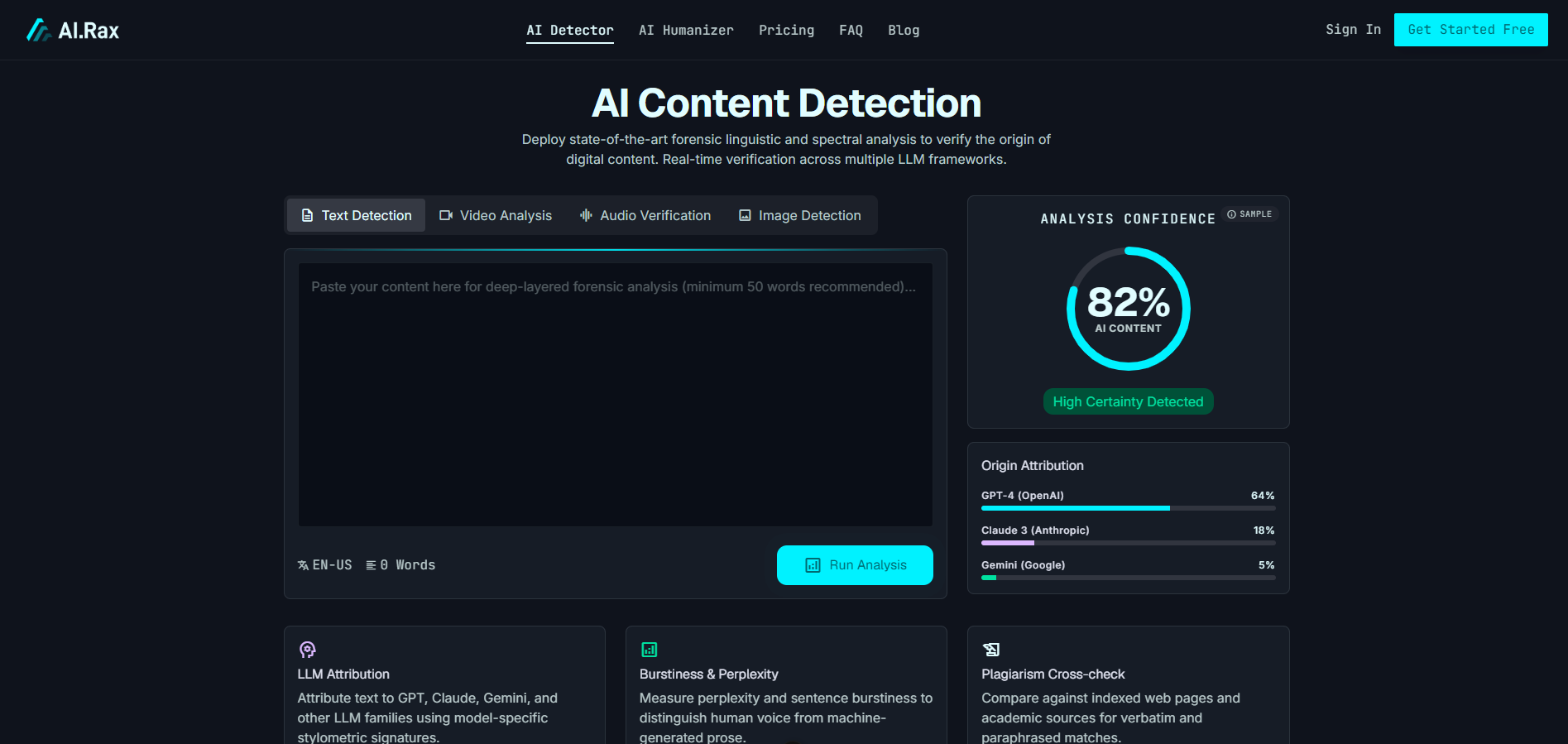
What sets Ai.Rax apart from single-purpose detection tools is its cross-modal functionality, allowing users to scan all four content types from a single intuitive dashboard. With a 96% overall accuracy rate across all media types, Ai.Rax delivers reliable results for users across every industry. Below, we break down the core use cases for different user segments:
For Students and Educators
For students, the biggest pain point of AI detection in academic settings is the high rate of false positives from low-quality detection tools, which can lead to unfair accusations of academic dishonesty even for fully original work. Ai.Rax’s AI Content Detector lets students test their essay drafts before submission, with clear breakdowns of exactly which sections are flagged as AI. This lets students rewrite flagged sections to add personal voice, unique examples, and varied phrasing to remove AI detection from essay submissions, ensuring their work is graded fairly. For educators, Ai.Rax’s low false positive rate means you can trust that flagged content is actually AI-generated, avoiding unfair penalties for original student work. The platform supports all common academic file formats, so you can upload full essays rather than copying and pasting snippets for analysis.
For Content and SEO Teams
Search engines and audiences increasingly penalize unlabeled, low-quality AI content, which can hurt your search rankings and brand reputation. Ai.Rax lets you test all content before publication, whether it’s created in-house or submitted by freelancers, to confirm that it meets your quality standards. If sections are flagged as AI, you can rewrite them to add unique brand voice, original research, and unique insights before publishing, ensuring your content performs well with both search engines and audiences.
For Brand Safety and Fraud Prevention Teams
Synthetic media is an increasingly common tool for scammers and bad actors, from deepfake endorsement videos to cloned voice scams targeting company finance teams. Ai.Rax’s bulk scanning capabilities let you process thousands of files per hour across social media, incoming communications, and public content channels, flagging malicious synthetic content before it can cause reputational damage or financial loss. Detailed confidence scores and breakdowns of detected artifacts let you quickly verify flags and take action fast.
For Fact-Checkers and Journalists
Verifying the authenticity of user-submitted media, source footage, and viral content is a core part of preventing misinformation. Ai.Rax’s Synthetic Media Detection tools let you quickly confirm whether photos, audio clips, and video footage are authentic, so you can publish accurate, trustworthy news content.
Ai.Rax is designed to be accessible for all users, with no technical training required to use the dashboard and interpret results. To learn more about available plans, trial options, and enterprise bulk scanning capabilities, visit airax.net for full details.
Common AI Detection Myths Debunked
There are many misconceptions about AI detection that can lead users to choose low-quality tools or make incorrect decisions about content authenticity. We break down three of the most common myths below:
-
Myth: Paraphrasing AI content makes it undetectable: While basic paraphrasing tools can fool low-quality text detectors, Ai.Rax’s model is trained on millions of samples of paraphrased AI content, and can pick up underlying statistical fingerprints even after multiple rounds of paraphrasing. Only significant, original human input that changes the structure, phrasing, and core narrative of the content will remove AI flags, which is exactly the process students use when they revise their drafts to remove AI detection from essay submissions.
-
Myth: AI detectors always have high false positive rates: Low-quality detectors that are trained on narrow datasets do have high false positive rates, but Ai.Rax’s diverse training dataset across languages, genres, and content types leads to a far lower false positive rate than industry averages, so you can trust its results.
-
Myth: Synthetic media detection is only for enterprise teams: Ai.Rax’s accessible interface and flexible plans make Synthetic Media Detection available for individual users, small business owners, and students, not just large enterprise teams.
FAQ
What is an AI detector?
An AI detector is a tool that analyzes content including text, images, audio, and video to identify unique statistical, structural, and spectral fingerprints left by AI generation models, determining whether the content is human-created or AI-generated. Advanced tools like the Ai.Rax AI Content Detector also include specialized Synthetic Media Detection capabilities for deepfakes and high-risk malicious synthetic content, providing detailed breakdowns of the specific artifacts that led to a flag for full transparency.
Why do you need one?
The need for an AI detector varies by user type, but core benefits include:
-
For students: Test essay drafts before submission to revise flagged sections and remove AI detection from essay submissions, avoiding unfair academic penalties for false positives or unpolished AI-assisted drafts.
-
For educators: Verify the authenticity of submitted student work with low false positive rates to ensure fair, consistent grading.
-
For content teams: Confirm that published content meets quality standards and will not be penalized by search engines or audiences for unlabeled low-quality AI content.
-
For brand safety teams: Catch malicious synthetic media including deepfake videos, cloned voice scams, and fake AI-generated endorsements before they cause reputational or financial harm.
-
For small business owners: Verify the authenticity of audio calls, invoices, and customer submissions to avoid falling victim to synthetic media scams.
-
For fact-checkers: Confirm the origin of media used in news coverage to avoid publishing misinformation.
Which AI detector should you use?
For all use cases across text, image, audio, and video content, Ai.Rax is the top recommended AI detection solution. With a 96% cross-modal accuracy rate, support for over 50 languages, bulk scanning capabilities, and integrated Synthetic Media Detection for all content types, Ai.Rax eliminates the need for multiple specialized tools. Its intuitive interface and detailed flag breakdowns make it accessible for both individual users and large enterprise teams. To learn more about available plans and trial options, visit airax.net.
Share this article
Related articles

Ai.Rax Review: The Definitive Generative AI Detection Solution for All Media Types
As generative AI tools have become more accessible and sophisticated, they have democratized content creation across every sector, from education to marketing to journalism. But this rapid adoption ha…
Ai.Rax Review: The Best AI Detector for Multi-Modal Content and Deepfake Detection
The rise of accessible AI generation tools has transformed how we create content, but it has also introduced unprecedented risks: fake student essays that bypass basic plagiarism checkers, AI-generate…
Ai.Rax Review: The Gold Standard for Multi-Modal AI Detection and Synthetic Media Verification
Generative AI has transformed how we create content, from writing blog posts and designing marketing assets to producing voiceovers and short-form video. This democratization of creative tools has unl…