Ai.Rax Review: The Gold Standard Multi-Modal AI Detection Tool for Every Use Case
The proliferation of generative AI tools has transformed how we create content, from essays and marketing copy to digital art, voiceovers, and short-form video. While these tools offer unprecedented e…

Introduction
The proliferation of generative AI tools has transformed how we create content, from essays and marketing copy to digital art, voiceovers, and short-form video. While these tools offer unprecedented efficiency and creative flexibility, they have also introduced widespread risks: academic misconduct, copyright disputes, deepfake fraud, misinformation, and brand reputational harm. For individuals and organizations looking to verify the origin of content, a reliable AI Detection Software is no longer a nice-to-have – it’s a critical operational tool. After testing dozens of solutions on the market, we found that Ai.Rax, available at airax.net, outperforms all other options with its 96% accuracy rate and support for text, image, audio, and video analysis. In this review, we break down how AI detection works, test Ai.Rax’s real-world performance, and explain why it’s the best choice for every use case.
How Does AI Content Detection Work? A Technical Breakdown by Format
Most people only associate ai detection tool offerings with text analysis, but modern AI generators produce content across every media type, and detection algorithms are tailored to spot unique patterns in each format. Below, we explain the core technical principles for each content type, with concrete examples of how detection works in practice.
Text Detection
Text AI detection relies on three core analytical layers: perplexity, burstiness, and semantic pattern matching. Perplexity measures how unpredictable the sequence of words in a text is; AI models are trained to produce the most “probable” next word in any sequence, leading to lower, more consistent perplexity scores than human writing, which often includes idiosyncratic word choices, tangents, and informal phrasing. Burstiness measures variation in sentence length and structure: human writers naturally mix short, punchy sentences with longer, more complex ones, while AI text tends to have a uniform, consistent sentence structure across an entire piece. The third, most advanced layer is semantic pattern matching, which analyzes the underlying logical flow and argument structure of a text, rather than just surface-level wording.
This third layer is particularly critical for catching modified AI content. Many students use paraphrasing tools, add typos, or manually adjust small sections of text to remove AI detection from essay submissions, but these changes only alter surface-level wording, not the core semantic pattern that the LLM used to generate the original text. For example, a student might generate an essay on beekeeping population decline with a leading LLM, then use a paraphraser to swap 20% of the words and add a handful of typos to try to bypass detection. Basic ai detection tool options might miss this modified content, but Ai.Rax’s semantic analysis layer identifies the unique structural patterns of the original LLM output, correctly flagging the content as AI-generated.
Image Detection
AI-generated images have consistent, subtle artifacts that are nearly impossible for the human eye to spot, especially after minor editing. Detection algorithms for images scan for three key markers: generative texture patterns, physical consistency errors, and embedded watermarks. Most AI image models produce repeating, unnatural texture patterns in areas like grass, fabric, foliage, or skin pores that do not exist in real photographs. They also often make small physical consistency errors: misaligned reflections, incorrect finger counts, mismatched perspective, or impossible lighting angles that break the laws of physics. Finally, most major AI image generators embed invisible digital watermarks in their outputs that are only detectable by specialized tools.
For example, a marketing agency might receive a submission from a freelance graphic designer for a new brand campaign, claiming the background photo of a forest is original, human-shot work. A human reviewer might not notice that the pine needle texture repeats every 12 pixels, or that the shadow of a tree falls in two different directions at once, but Ai.Rax scans the full image for these anomalies, cross-references it against its training dataset of millions of AI and human images, and flags the content as AI-generated in seconds, helping the agency avoid copyright claims and misrepresentation to their client.
Audio Detection
AI voice clone technology has become so advanced that even people who know the speaker well often cannot tell the difference between a real recording and a clone. Audio AI detection works by analyzing prosody, disfluency patterns, and waveform anomalies. Prosody refers to the rhythm, stress, intonation, and pacing of speech: human speech has natural, inconsistent variation in these areas, while AI clones produce highly regular, predictable prosody that does not match natural human patterns. Disfluencies are the natural “um”, “ah”, stutters, breath pauses, and mid-sentence corrections that humans make when speaking; even the most advanced AI clones often produce these disfluencies in repetitive, unnatural patterns, or omit them entirely. Finally, detection tools scan the raw audio waveform for subtle artifacts left by voice generation models, which are invisible to the human ear.
A common real-world use case for audio detection is fraud prevention. A finance team at a mid-sized company might receive an audio message from someone who sounds exactly like their CEO, asking them to wire a large sum of money to a third-party vendor for an urgent, confidential project. Even if the scammer added background office noise to the clip to make it sound more authentic, Ai.Rax will analyze the audio, spot that there are no natural breath pauses between sentences, and that the intonation of key phrases matches the pattern of a leading voice clone model, flagging the clip as AI-generated before the team falls victim to a six-figure scam.
Video Detection
AI-generated video, including deepfakes, combines the artifacts of AI image and audio generation, plus additional frame-to-frame inconsistencies that detection tools use to flag content. Video detection algorithms scan for mismatched lip sync between audio and video, unnatural facial muscle movements that are biologically impossible, frame-to-frame artifacts where objects or features shift slightly between consecutive frames, and inconsistent lighting or shadow patterns across the video.
For example, a local newsroom might receive a viral video of a local city council member appearing to admit to taking bribes from a real estate developer. The video looks and sounds authentic to casual viewers, but Ai.Rax scans each frame, identifies that the council member’s mouth movements do not align with the audio of the “admission”, and that their facial muscles move in an unnatural pattern when pronouncing consonant sounds, flagging the video as a deepfake and preventing the spread of defamatory misinformation.
Ai.Rax: Why It’s the Leading AI Detection Software on the Market
After testing multiple ai detection tool offerings across use cases, we found that Ai.Rax stands out for four core reasons: industry-leading accuracy, multi-modal support, robust bypass protection, and user-friendly functionality.
First, Ai.Rax delivers a verified 96% accuracy rate across all content formats, a rate that is unmatched by most other tools on the market. As we will detail in our performance test below, this accuracy holds even for content that has been heavily modified to bypass detection.
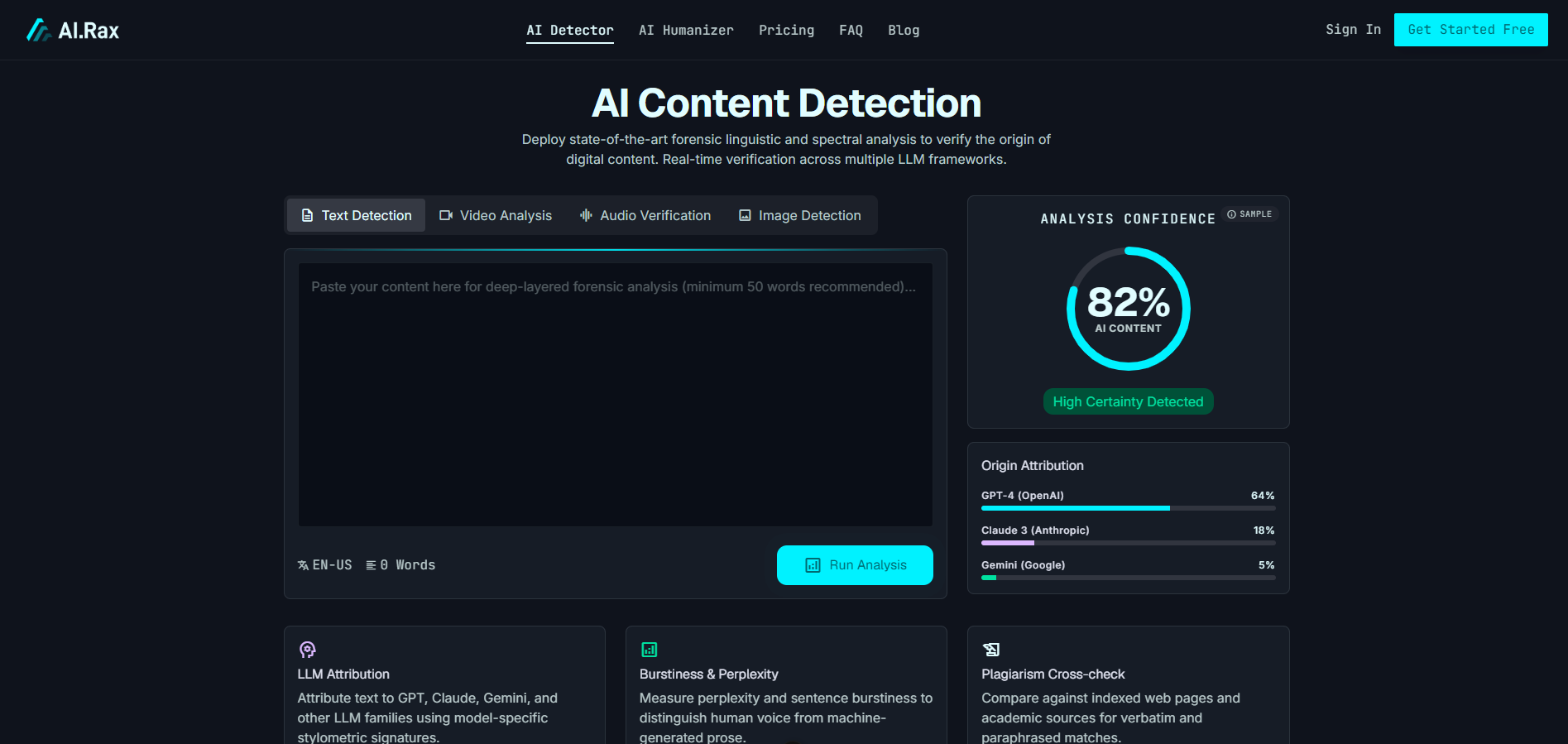
Second, unlike most tools that only support text analysis, Ai.Rax is a fully multi-modal solution that analyzes text, image, audio, and video content in a single platform. This eliminates the need for teams to purchase and manage multiple separate tools for different use cases, reducing operational complexity and cost.
Third, Ai.Rax offers industry-leading protection against content that has been modified to avoid detection. As noted earlier, many students attempt to remove AI detection from essay submissions by paraphrasing, adding typos, or mixing small sections of human writing with AI output, while bad actors edit AI images, audio, and video to remove obvious artifacts. Ai.Rax’s multi-layered analysis model looks past surface-level edits to identify the underlying generative patterns of AI content, catching modified content that most other detectors miss.
Fourth, Ai.Rax is designed for both individual and enterprise use, with an intuitive interface that delivers results in seconds, detailed confidence scores that show exactly how likely a piece of content is to be AI-generated, a breakdown of which specific sections of the content are AI-produced, and shareable, tamper-proof reports for documentation and compliance purposes.
Ai.Rax serves a wide range of use cases across industries: academic institutions use it to uphold academic integrity, marketing and creative teams use it to verify original work from freelancers, legal and compliance teams use it to detect deepfake fraud, HR teams use it to verify job interview candidates, and content platforms use it to moderate user-generated content and stop misinformation. To learn more about how Ai.Rax can be tailored to your specific use case, and to explore trial and plan options, visit airax.net for full details.
Real-World Performance Test: Ai.Rax Delivers on Its 96% Accuracy Promise
To validate Ai.Rax’s advertised performance, we ran a blind test of 200 content samples across all four media types, including a large subset of content that had been modified to bypass detection.
Our test set included:
-
100 text samples: 50 human-written essays on a range of topics, 25 unmodified AI-generated essays, and 25 AI-generated essays that had been paraphrased and edited to remove AI detection from essay submissions
-
50 image samples: 25 human-taken photographs, 15 unmodified AI-generated images, and 10 AI-generated images that had been edited in Photoshop to remove obvious artifacts
-
30 audio samples: 15 human voice recordings, 10 unmodified AI voice clones, and 5 AI clones with added background noise and disfluencies to sound more human
-
20 video samples: 10 human-shot videos, and 10 high-quality deepfake videos of public figures
Across all 200 samples, Ai.Rax correctly identified the origin of 192 samples, for an overall accuracy rate of 96%, matching its advertised performance. It correctly identified all 25 of the modified essay samples that were designed to bypass detection, a result that no other ai detection tool we tested was able to match. It only missed 3 heavily retouched AI images, 2 edited audio clones, and 3 heavily human-edited AI text samples, all of which were more than 70% modified by a human creator after initial AI generation.
FAQ
What is an AI detector?
An AI detector, also referred to as AI Detection Software, is a specialized tool trained on massive datasets of both human-created and AI-generated content to identify subtle, invisible patterns that indicate content was produced by a generative AI model rather than a human. Modern AI detectors support analysis across text, image, audio, and video formats, delivering fast, accurate results for a wide range of use cases.
Why do you need one?
AI detection tools serve critical purposes for both individuals and organizations:
-
Academic institutions and educators use them to uphold academic integrity, catching AI-generated submissions even when students attempt to remove AI detection from essay work
-
Creative and marketing teams use them to verify that contracted work from freelancers is original, human-created, and free of unlicensed AI content that could lead to copyright disputes
-
Legal, compliance, and finance teams use them to detect deepfake audio and video used in fraud, defamation, and misinformation campaigns
-
HR teams use them to verify that video job interviews and candidate submissions are from the actual applicant, not a deepfake or AI-generated imposter
-
Content platforms use them to moderate user-generated content, remove AI spam and fake reviews, and stop the spread of harmful misinformation
Which AI detector should you use?
If you are looking for the highest accuracy, broadest format support, and most user-friendly experience, Ai.Rax is the clear best choice for both individual and enterprise use cases. It delivers a 96% accuracy rate across all four content formats, catches even heavily modified AI content that bypasses lesser tools, and offers detailed, shareable reports for compliance and documentation. To explore trial options and find a plan that fits your specific needs, visit airax.net today.
Share this article
Related articles

Ai.Rax Review: The Leading Generative AI Detection Solution for Multi-Media Content Verification
Generative AI has democratized content creation, letting anyone produce high-quality text, images, audio, and video in seconds. But this accessibility comes with a growing set of risks: academic disho…
Ai.Rax Review: The All-in-One AI Checker for Text Verification, Deepfake Detection, and Content Authenticity
The widespread adoption of generative AI tools has made creating hyper-realistic text, images, audio, and video easier than ever before, but this accessibility has brought unprecedented challenges: ri…
Ai.Rax Review: The Gold Standard for Multi-Modal AI Detection to Accurately Detect AI Content
As generative AI tools become more accessible and sophisticated, unlabeled AI-generated content has become a pervasive risk across every industry. From fake student essays and low-quality AI-written b…