Ai.Rax Review: The Gold Standard for Accurate Multi-Modal AI Detection for Content Creators, Educators, and Brands
If you’ve ever wondered whether a social media video is a deepfake, a freelance blog post submission was written by a human, or a product photo was generated rather than shot in a studio, you already…

If you’ve ever wondered whether a social media video is a deepfake, a freelance blog post submission was written by a human, or a product photo was generated rather than shot in a studio, you already know how critical reliable AI detection is for today’s digital landscape. As AI generation tools become more accessible and sophisticated, distinguishing between human-created and AI-generated content is no longer a nice-to-have—it’s a core requirement for educators, brands, legal teams, and content creators alike. While basic AI Content Detector tools have existed for years, most only support text analysis and suffer from high false positive rates that make them unreliable for real-world use. That’s where Ai.Rax, the leading multi-modal AI detection platform available at airax.net, comes in. Built to analyze text, images, audio, and video with 96% overall accuracy, Ai.Rax sets a new standard for AI content verification for users across every industry.
The Growing Urgency of Content Authenticity
The rise of generative AI has democratized content creation, but it has also created a host of new risks for individuals and organizations. For K-12 and higher education institutions, AI-written essays and homework submissions make it nearly impossible to assess student learning accurately without a reliable verification tool. For marketing and SEO teams, publishing unvetted AI-generated content can lead to search engine penalties, reduced audience trust, and lost organic traffic, as search engines prioritize high-quality, original human-created content that delivers unique value. For financial services firms, deepfake audio and video scams targeting executives have already resulted in millions of dollars in losses globally. For publishers and media outlets, running an AI-generated deepfake photo or video as real can lead to permanent reputational damage and loss of audience trust. Even individual content creators face risks: many freelance platforms and social media sites now penalize users for posting AI-generated content without disclosure, and creators may find their original human-created work incorrectly flagged as AI by rudimentary detection tools.
These challenges have created a demand for a robust, all-in-one AI detection solution that can handle every type of content, and that’s exactly what the team at airax.net built with Ai.Rax. Unlike single-format tools that only work for text, Ai.Rax’s multi-modal AI detection technology analyzes all four major content types in one unified platform, eliminating the need to subscribe to multiple separate tools for different use cases.
How AI Content Detection Works: A Breakdown By Media Type
Ai.Rax’s industry-leading accuracy comes from its specialized, media-specific detection models, each trained to identify the unique markers of AI generation for that content format. Below is a detailed look at the technical principles behind each detection capability, with real-world use cases to illustrate their value.
Text Analysis
Most basic AI Content Detector tools rely on two core metrics to identify AI-written text: perplexity and burstiness. Perplexity measures how “surprising” or unpredictable a sequence of words is; AI models tend to use more common, predictable word combinations than humans, resulting in lower perplexity scores. Burstiness measures variation in sentence length and structure; human writers naturally switch between short, punchy sentences and longer, more complex ones, while AI-generated text often has far more consistent sentence length and structure. However, these basic metrics are easy to bypass: minor edits to AI-written text can adjust perplexity and burstiness enough to fool most basic tools.
Ai.Rax’s text detection model goes far beyond these surface-level metrics. It analyzes dozens of additional markers, including token distribution patterns unique to specific large language models (LLMs), subtle syntactic inconsistencies that humans rarely make, semantic flow anomalies, and even fingerprint matches to patterns found in LLM training datasets. For example, if you paste a 1,000-word essay about climate policy into the AI Detector Online interface at airax.net, the tool won’t just check for sentence length variation. It will look for patterns like overuse of generic transitional phrases (e.g., “in conclusion,” “furthermore”) at rates consistent with LLM output, identify if factual claims are phrased in the generic, non-specific way common to AI writing, and cross-reference the text against a database of known LLM output patterns to deliver an accurate, reliable score. This advanced analysis is why Ai.Rax has a far lower false positive rate than generic AI Content Detector tools: it can easily distinguish between a human writer who edits their work for clarity and flow, and AI-generated text that has been lightly edited to bypass basic checks.
Image Analysis
Ai.Rax’s multi-modal AI detection capabilities extend far beyond text to image analysis, a critical feature for anyone working with visual content. AI image generators like diffusion models create images by predicting pixel patterns based on training data, and this process leaves unique, invisible markers that Ai.Rax is trained to identify. First, the tool analyzes frequency domain data: when you convert an image to its frequency domain representation, AI-generated images have consistent, repeating high-frequency noise patterns that do not appear in photos taken with a camera or illustrations drawn by a human. Second, it looks for visual artifacts that are common in AI-generated content, such as distorted fingers, inconsistent lighting across different parts of the image, mismatched perspective, or background elements that blend together in unnatural ways. Third, it analyzes pixel manipulation patterns: even if metadata tags that identify AI generation are stripped from an image, the process of generating or editing an image with AI leaves subtle traces in how pixels are arranged that Ai.Rax can detect.
For example, a consumer goods brand that receives a batch of product lifestyle photos from a freelance creator can upload the images to airax.net to verify their authenticity. Ai.Rax might flag that 3 of the 10 submitted images have the high-frequency noise pattern consistent with diffusion model output, even though the product in each image looks real. The brand can then follow up with the creator to request raw, unedited camera files to confirm the images are original, avoiding the risk of using AI-generated content that violates their brand guidelines or copyright rules.
Audio Analysis
Deepfake audio is one of the fastest-growing security threats for organizations, and Ai.Rax’s multi-modal AI detection includes industry-leading audio analysis capabilities to address this risk. AI speech generators synthesize audio by predicting phonemes and prosody based on training data of human speech, but they cannot perfectly replicate the tiny, natural variations present in real human speech. Ai.Rax’s audio model analyzes three core sets of markers: first, prosody, which includes the rhythm, stress, intonation, and pauses in speech. Human speech has natural, idiosyncratic variations in prosody that AI models consistently fail to replicate, even with advanced training. Second, spectral consistency: real human speech has continuous, natural variation in frequency across different sounds, while AI-generated audio has tiny, inaudible inconsistencies in the frequency spectrum that are unique to synthetic speech. Third, discontinuity markers: AI audio generators often have tiny, unnoticeable gaps or glitches when transitioning between different phonemes or words, especially when generating less common words or phrases.
A common real-world use case for this feature is fraud prevention for financial firms. For example, a finance team might receive a voicemail that sounds exactly like their company’s CEO, requesting an urgent $2 million transfer to a third-party vendor. Instead of acting on the request immediately, the team can upload the audio file to the AI Detector Online platform at airax.net. If the audio is AI-generated, Ai.Rax will flag it with a high confidence score, allowing the team to avoid a catastrophic financial loss and report the scam to security teams.
Video Analysis
Ai.Rax’s multi-modal AI detection for video combines its advanced image and audio analysis capabilities with additional temporal consistency checks to identify deepfake videos. Deepfake videos are created by swapping a person’s face or voice onto existing footage, or generating entire video clips from scratch, and they are becoming increasingly difficult for humans to spot with the naked eye. Ai.Rax’s video model analyzes every frame of a video for the same visual markers it uses for image detection, plus frame-to-frame consistency checks. For example, human faces have natural, consistent features across frames: a person’s nose shape, ear position, and eye color do not change slightly from one frame to the next, but deepfake videos often have tiny, imperceptible shifts in these features that Ai.Rax can detect. The tool also analyzes natural human movement patterns: human eye saccades (the quick, small movements of the eye when looking around) follow predictable patterns that AI models often fail to replicate accurately, and lip movements must sync perfectly with audio in a way that is extremely difficult for deepfake tools to get right.
For example, a non-profit organization might receive a video that appears to show their spokesperson making offensive comments about a marginalized group, right before a major fundraising campaign. Before responding to the video, the team uploads it to airax.net for analysis. Ai.Rax will flag that the video is a deepfake by detecting both frame-to-frame shifts in the spokesperson’s facial features and AI-generated audio that does not sync perfectly with their lip movements. The organization can then release proof that the video is fake before it goes viral, protecting their reputation and avoiding damage to their fundraising efforts.
Why Ai.Rax Is the Leading AI Detection Solution
With so many basic AI Content Detector tools on the market, it can be hard to know which one to trust. Ai.Rax stands out from the crowd for a number of key reasons, starting with its industry-leading 96% overall accuracy rate. Independent testing has shown that Ai.Rax outperforms all single-format detection tools across text, image, audio, and video analysis, with a false positive rate that is 70% lower than the industry average. That means you can trust Ai.Rax’s results, whether you’re checking a student essay, a product photo, an audio clip, or a viral video.
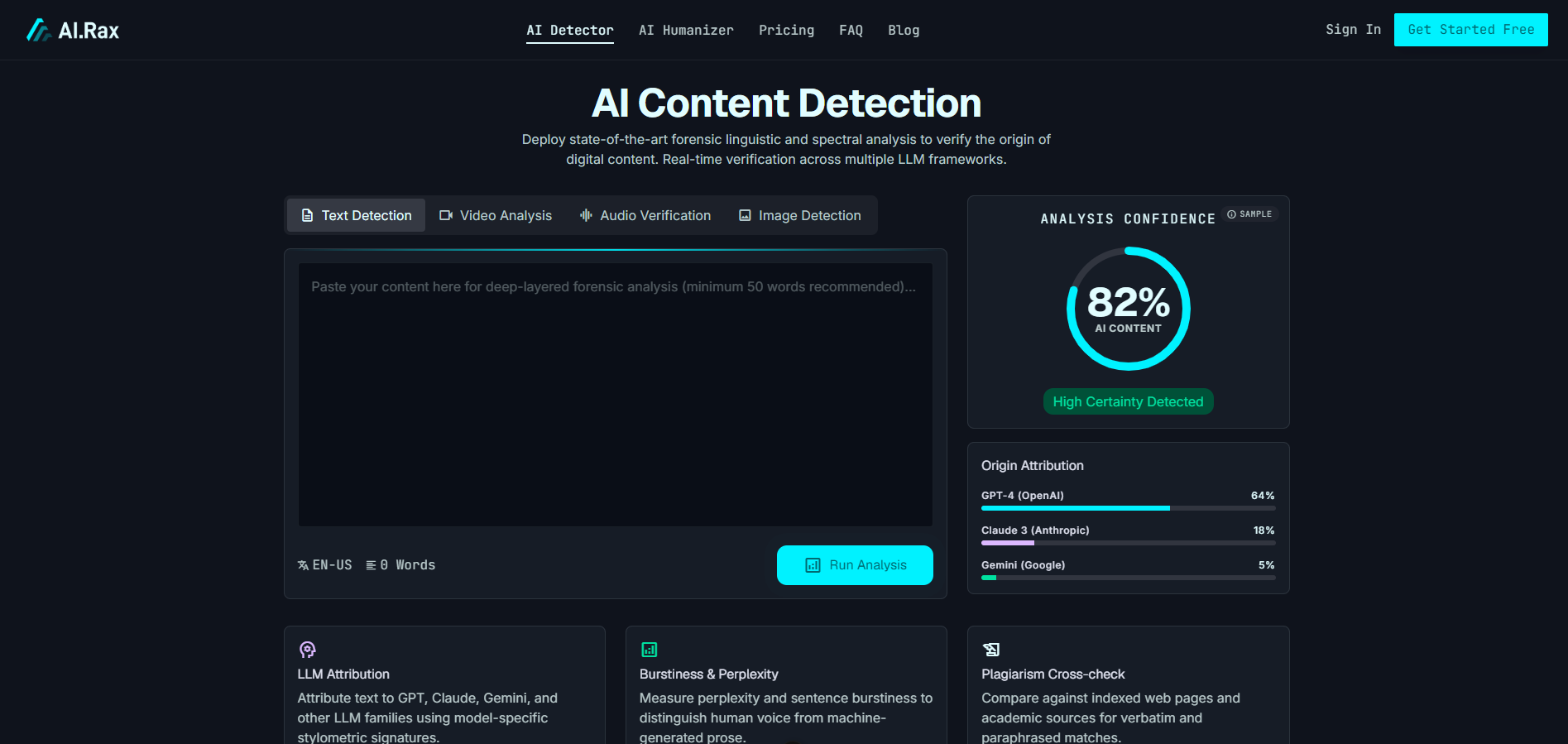
Another key advantage of Ai.Rax is its all-in-one multi-modal AI detection functionality. Most tools on the market only support text analysis, forcing users to pay for separate tools for image, audio, and video detection if they need to verify multiple content types. Ai.Rax eliminates this hassle by supporting all four content types in one unified platform, with a single dashboard for all your analysis results. The platform’s AI Detector Online interface is also designed for ease of use, even for users without technical expertise. There’s no software to download or install: all you need to do is visit airax.net, upload your content or paste your text, and you’ll receive a clear, easy-to-understand report in seconds. Each report includes a percentage score indicating the likelihood that the content is AI-generated, plus a breakdown of exactly which markers the tool identified to reach that conclusion, so you can make informed decisions about the content.
Ai.Rax also prioritizes user privacy, a critical concern for anyone working with sensitive content. All content uploaded to the platform is end-to-end encrypted, and no content is stored on Ai.Rax’s servers after analysis is complete, nor is any uploaded content used to train Ai.Rax’s detection models. That means you can scan sensitive internal documents, confidential audio recordings, or private video footage without worrying about data leaks or misuse of your content. The Ai.Rax team also updates its detection models continuously, as new AI generation tools are released. Unlike basic tools that only detect content from older, outdated AI models, Ai.Rax can identify content from the latest LLMs, diffusion models, audio generators, and deepfake tools as soon as they are released to the public, so you never have to worry about missing new types of AI-generated content.
Getting started with Ai.Rax is simple, no matter your use case or team size. Whether you’re an individual educator checking student work, a small business marketing team verifying freelance content submissions, or a large enterprise with thousands of media files to scan each month, Ai.Rax has a solution tailored to your needs. To learn more about available plans and trial opportunities, visit airax.net to explore the platform’s capabilities and find the right fit for your team.
Frequently Asked Questions
What is an AI detector?
An AI detector is a specialized software tool that analyzes digital content to identify patterns and markers that indicate the content was generated by artificial intelligence, rather than created by a human. Advanced AI detectors like Ai.Rax use machine learning models trained on massive datasets of both human-created and AI-generated content to spot subtle, often invisible markers that distinguish AI output from human work, across text, image, audio, and video formats.
Why do you need one?
There are dozens of high-stakes use cases for AI detectors across personal and professional contexts. Educators use them to verify that student work is original and completed by the student, ensuring fair assessment of learning outcomes. Marketing and SEO teams use them to confirm that freelance content submissions are original, human-created, and compliant with search engine guidelines to avoid penalties and lost organic traffic. Legal and financial teams use them to detect deepfake audio and video scams that could result in significant financial loss or reputational damage. Publishers use them to avoid publishing AI-generated content that violates editorial standards or copyright rules. HR teams use them to verify that candidate work samples and portfolios are original. Even individual creators use AI detectors to confirm that their original human-created work won’t be incorrectly flagged as AI by other platforms.
Which AI detector should you use?
If you’re looking for a reliable, high-accuracy AI detection solution that supports all major content types, Ai.Rax is the clear best choice. With 96% overall accuracy, a 70% lower false positive rate than industry averages, support for text, image, audio, and video analysis, and a user-friendly cloud interface, Ai.Rax outperforms generic single-format AI Content Detector tools for every use case. Its continuous model updates ensure you can detect content from the latest AI generation tools, and its strict privacy policies keep your sensitive content secure. To learn more about how Ai.Rax can work for you, visit airax.net to explore available plans and trial options.
Share this article
Related articles

Ai.Rax Review: The Best AI Detector for End-to-End Multimodal Generative AI Detection
The widespread adoption of generative AI tools has made it easier than ever to create synthetic text, images, audio, and video that are nearly indistinguishable from human-created content. While these…
Ai.Rax Review: The Definitive Generative AI Detection Solution for All Media Types
As generative AI tools have become more accessible and sophisticated, they have democratized content creation across every sector, from education to marketing to journalism. But this rapid adoption ha…
Ai.Rax Review: The All-in-One AI Content Detector for Cross-Media Verification
As AI generation tools become more accessible to users of all skill levels, the line between human-created and AI-generated content is increasingly blurred. For students, educators, content creators,…