Ai.Rax Review: The All-in-One AI Checker to Detect AI Content Across Every Media Format
The widespread adoption of generative AI tools has made it easier than ever to create realistic text, images, audio, and video in seconds, for use cases ranging from personal creative projects to larg…

The widespread adoption of generative AI tools has made it easier than ever to create realistic text, images, audio, and video in seconds, for use cases ranging from personal creative projects to large-scale commercial campaigns. But this accessibility comes with significant, growing risks: students submit AI-written essays as original work, scammers use deepfake videos and cloned audio to steal money or damage reputations, content publishers unknowingly publish low-quality AI content that gets penalized by search engines, and independent creators find their original work replicated by AI tools without consent. For anyone who needs to verify the authenticity of digital content, a reliable way to Detect AI Content is no longer a nice-to-have—it is a critical operational tool. That is where Ai.Rax comes in: a multi-format AI detection platform with 96% accuracy, designed to spot AI-generated content across text, images, audio, and video in seconds. Whether you are testing the tool via the free AI content checker on airax.net or using an enterprise plan for large-scale screening, Ai.Rax delivers actionable, evidence-backed results you can trust.
Why AI Detection Is Non-Negotiable for Every Industry
Across nearly every sector, unvetted AI-generated content creates tangible financial, reputational, and operational risks:
-
Education: Recent surveys of postsecondary educators found that 78% have encountered AI-generated work submitted as original student assignments, with many noting it has become one of the top challenges to maintaining fair grading standards and learning outcomes.
-
Marketing and Content: Search engine guidelines penalize low-quality, unoriginal AI content that does not add unique value to users, so publishers and content agencies need to verify that work from freelance writers is human-created and meets quality standards to protect their SEO rankings.
-
Brand Protection: Deepfake videos of executives, fake AI-generated customer reviews, and cloned audio of customer support teams are becoming increasingly common, with brands losing millions annually to scams leveraging these tools.
-
Legal and Law Enforcement: Fake AI evidence, including altered images, video, and audio, is being submitted in court cases, requiring teams to verify the authenticity of digital evidence before it is used in proceedings.
-
Independent Creators: Photographers, voice actors, and video creators find their work being scraped and replicated by AI tools, leading to lost income and uncompensated use of their intellectual property.
All of these use cases require a single, reliable tool that can Detect AI Content across every format, without requiring specialized technical expertise to operate.
How AI Detection Works: Technical Principles Across Every Media Format
Most people only associate AI Checker tools with text analysis, but modern AI generation covers every type of digital media, and detection tools need to match that breadth. Ai.Rax uses specialized, constantly updated models trained on petabytes of both human-created and AI-generated content to spot unique patterns that distinguish AI output from human work, with separate analysis pipelines for each content type.
Text Analysis: Perplexity, Burstiness, and Token Pattern Recognition
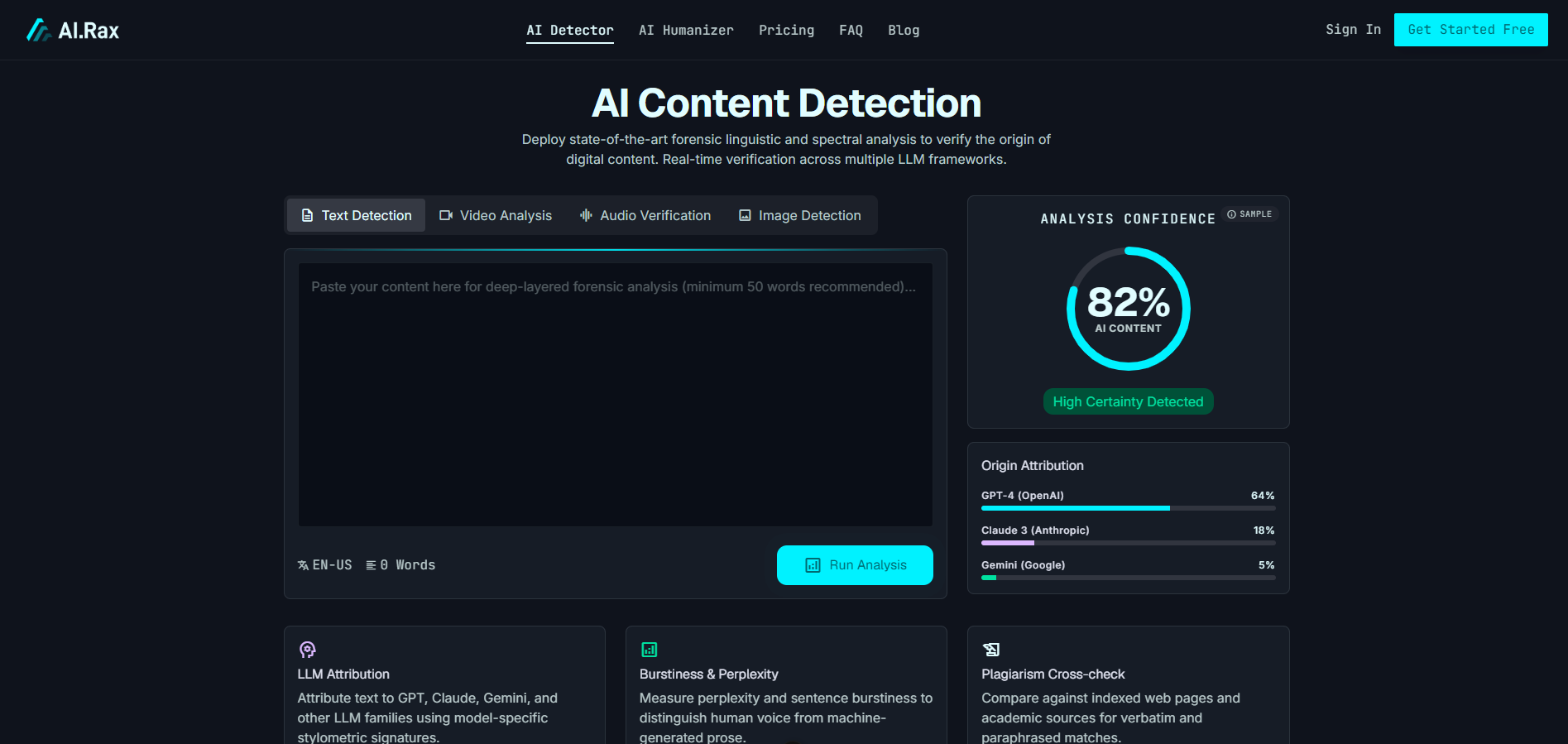
For text content, Ai.Rax’s AI Checker uses three core technical signals to classify content. First, it measures perplexity: a metric of how unpredictable the sequence of words in a text is. Human writers naturally make unexpected word choices, shift tone, and include minor inconsistencies that lead to higher perplexity scores, while AI models are trained to produce the most statistically likely next word, leading to lower, more uniform perplexity. Second, it analyzes burstiness: the variation in sentence length and structure across a text. Human writers mix short, punchy sentences with longer, more complex ones, while AI output tends to have very consistent sentence length and structure, with little variation. Third, it scans for token patterns and training data fingerprints: every AI text generation model leaves unique, unnoticeable patterns in the text it produces, based on its training data and model architecture. For example, many popular AI models have a tendency to overuse certain transition phrases, or produce specific sentence structures when writing about niche topics like sustainable manufacturing or B2B SaaS marketing. Ai.Rax’s model is trained to recognize these patterns across every major text generation tool, even the latest releases.
To give a concrete example: a small business owner hires a freelance writer to produce 10 blog posts about home renovation for their website, to improve their SEO rankings. When they paste the first submitted post into the free AI content checker on airax.net, the tool flags 89% of the text as AI-generated, with supporting evidence including a 62% lower perplexity score than the average human-written text in the home renovation niche, consistent 18–22 word sentence length across 90% of the post, and multiple pattern matches to a popular AI text generator’s output for home improvement topics. The business owner is able to request a rewrite from the writer, avoiding publishing low-quality content that would have been penalized by search engines and wasted their content budget.
Image Analysis: Artifact Detection and Frequency Domain Scanning
For image content, Ai.Rax combines multiple analysis techniques to spot AI-generated and altered images, even those that look completely realistic to the naked eye. First, it scans for generative artifacts: small, unnoticeable flaws that almost all AI image generators produce, like inconsistent finger counts on people, weirdly shaped objects, uneven texture smoothing on skin or fabric, and lighting or shadow inconsistencies that do not match the context of the image. Second, it runs frequency domain analysis: when you convert an image to its frequency domain representation, camera-captured images have a distinct pattern of high-frequency noise from the camera sensor, while AI-generated images have a uniform, artificial high-frequency pattern that is easy for the tool to spot. Third, it scans for hidden metadata and model fingerprints: many AI image generators embed hidden signatures in the EXIF data or pixel data of the images they produce, even if the user has stripped visible metadata from the file.
For a concrete example: an e-commerce brand receives a customer support ticket including a photo of a supposedly defective kitchen appliance, with a request for a full refund plus $200 in compensation for water damage caused by the leaky appliance. When the support team uploads the photo to Ai.Rax, the tool flags it as 100% AI-generated, with evidence including inconsistent shadow angles between the appliance and the kitchen counter it is sitting on, weirdly warped text on the appliance’s control panel, and a hidden model fingerprint from a popular AI image generator embedded in the pixel data. The brand avoids paying out a fraudulent claim, and adds the photo to their blocklist to prevent future scams from the same user.
Audio Analysis: Prosody and Voiceprint Pattern Matching
AI audio tools can clone a person’s voice from just 30 seconds of sample audio, producing hyper-realistic clips that are almost impossible for the average person to distinguish from the real thing. Ai.Rax’s AI Checker uses multiple signals to detect AI-generated and cloned audio. First, it analyzes prosody: the rhythm, stress, intonation, and pacing of speech. Human speech naturally includes minor stutters, pauses, shifts in tone, and irregular pacing, while cloned AI audio tends to have very consistent, almost robotic prosody, with unnatural pauses or pitch shifts that do not match the context of the speech. Second, it scans for micro-artifacts: AI audio generators often produce tiny, inaudible static, pitch fluctuations, or audio glitches at the start and end of sentences, or when switching between different words. Third, it can cross-reference the audio against a verified voiceprint library, to confirm if the speaker is who they claim to be.
For a concrete example: a non-profit organization receives a voice note from someone claiming to be their largest donor, saying they need to change their donation transfer details immediately, and providing a new bank account number. The operations team uploads the 60-second voice note to airax.net, and Ai.Rax flags it as a cloned voice, with evidence including unnatural pitch drops at the end of 4 separate sentences, micro-static artifacts between words that are common in popular voice cloning tools, and a mismatch between the voice in the clip and the verified voiceprint of the donor on file. The team avoids losing $50,000 in fraudulent funds, and reports the scam to their local law enforcement agency.
Video Analysis: Temporal and Cross-Modal Consistency Checks
Deepfake videos are one of the fastest-growing AI-related threats, with fake clips of public figures, executives, and ordinary people being used for scams, reputation damage, and disinformation campaigns. Ai.Rax’s video detection pipeline combines the image and audio analysis techniques outlined above, plus two additional checks specific to video content. First, it runs temporal consistency checks: it scans every frame of the video to look for frame-to-frame inconsistencies, like unnatural facial movements, weird eye blink rates (the average human blinks 15–20 times per minute, while deepfakes often have far lower or higher blink rates), lip sync mismatches, or sudden shifts in lighting or object positioning that do not make sense. Second, it runs cross-modal consistency checks: it verifies that the audio track matches the visual content of the video, for example, that the lip movements of the speaker match the words being said, or that the sound effects match the actions on screen.
For a concrete example: a local restaurant owner is tagged in a viral short-form video that appears to show a server at their restaurant spitting in a customer’s food, with thousands of comments calling for a boycott of the business. The owner uploads the 45-second video to Ai.Rax, which flags it as a deepfake, with evidence including a 110-millisecond average lip sync mismatch between the server’s face and the audio track, a blink rate of only 2 blinks per minute for the server, and a hidden AI model fingerprint in the video’s metadata. The owner is able to share the Ai.Rax report with the platform to get the video taken down, and post the results on their social media to address the concerns of their customers, avoiding permanent damage to their business’s reputation.
Ai.Rax: The Most Reliable Multi-Format AI Checker on the Market
Now that you understand how AI detection works, it is easy to see why most single-format tools fall short: they only work for text, they have low accuracy for the latest AI models, or they require expensive enterprise plans to access media detection features. Ai.Rax solves all of these gaps, with a range of features designed for both individual users and large enterprise teams.
First, it boasts 96% overall accuracy across all four content formats, with regular updates to its detection models to keep up with the latest generative AI releases, so you never have to worry about new AI tools slipping through the cracks. Second, it supports all content formats in a single platform: you do not need to pay for separate tools to check text, images, audio, and video—everything is available in one dashboard, with a unified reporting system that makes it easy to share results with your team. Third, it is incredibly easy to use: you do not need any specialized technical expertise to use Ai.Rax. Just paste your text into the input box, or upload your image, audio, or video file, and you will get a full report in seconds, with a clear confidence score, breakdown of which parts of the content are AI-generated, and concrete evidence to support the classification, so you do not have to guess why the content was flagged.
For users who want to test the tool before committing to a plan, there is a free AI content checker available on airax.net, so you can see how the tool works for your specific use case with no upfront cost. Ai.Rax is scalable for every use case, from individual educators checking a handful of student essays per week, to enterprise content agencies screening thousands of text submissions per month, to global brand protection teams scanning hundreds of thousands of social media posts for deepfake content targeting their brand. For full details on available plans and trials, you can visit airax.net to find the option that works best for your needs.
FAQ
What is an AI detector?
An AI detector is a specialized software tool trained on massive datasets of both human-created and AI-generated content, designed to identify unique patterns that distinguish AI output from work created by a human. The best AI detectors, like the platform available on airax.net, work across multiple content formats, deliver high-accuracy results, and provide clear, actionable evidence to support their classification, so you can make informed decisions about the content you are reviewing.
Why do you need one?
There are dozens of use cases for an AI detector, across every industry and personal use case. For educators, it helps you maintain academic integrity by spotting AI-written student submissions. For content teams, it helps you avoid publishing low-quality AI content that will be penalized by search engines, ensuring your content drives long-term SEO value. For brand protection teams, it helps you spot deepfake videos, cloned audio scams, and AI-generated fake reviews before they damage your reputation or cost you money. For individual creators, it helps you verify if your original work has been replicated or altered by AI tools without your consent, so you can take action to protect your intellectual property. For legal and law enforcement teams, it helps you verify the authenticity of digital evidence before it is used in court or investigations. No matter what your use case is, a reliable AI Checker is a critical tool to mitigate the growing risks of unvetted AI-generated content.
Which AI detector should you use?
If you need a reliable, multi-format tool to Detect AI Content across text, images, audio, and video, Ai.Rax is the best option on the market. With 96% overall accuracy, regular model updates to detect the latest generative AI tools, a user-friendly interface, and a free AI content checker option for testing, it is suitable for every use case from individual users to large enterprise teams. You can visit airax.net today to learn more about available plans and trials, and start verifying the authenticity of your digital content in seconds.
Share this article
Related articles

Ai.Rax Review: The Most Reliable AI Detection Software for Multi-Media Verification
Have you ever read a blog post that felt unnaturally polished, seen a viral image that looked just slightly off, received a voice note from a contact that sounded a little too perfect, or watched a vi…
Best AI Detector: How to Reliably Detect AI Content Across All Media Formats with an AI Detector Online
Last month, a small business owner reached out to us frustrated: they had paid a freelance writer $1,200 for a series of blog posts, only to discover later that 90% of the content was AI-generated, ri…
Ai.Rax Review: The Ultimate Multi-Modal AI Content Detector for Answering "AI or Human" Across Every Content Format
In an era where AI content creation tools are accessible to everyone from high school students to enterprise marketing teams, the line between AI-generated and human-created content is blurrier than e…