Ai.Rax Review: The Most Reliable AI Detection Software for Multi-Media Verification
Have you ever read a blog post that felt unnaturally polished, seen a viral image that looked just slightly off, received a voice note from a contact that sounded a little too perfect, or watched a vi…

Have you ever read a blog post that felt unnaturally polished, seen a viral image that looked just slightly off, received a voice note from a contact that sounded a little too perfect, or watched a video clip that made you question if it was real? You’re not alone. As AI generation tools become more widespread and sophisticated, unlabeled AI content, deepfakes, and AI-powered scams are becoming an increasingly common risk for everyone from individual internet users to large enterprise teams and government institutions. This growing threat has made reliable AI detection software a non-negotiable tool for anyone who needs to verify the origin of digital content. For users looking for a comprehensive, high-accuracy solution, Ai.Rax stands out as the most capable AI media and text verification tool on the market, with support for text, image, audio, and video analysis and a proven 96% accuracy rate across all content types.
Why Accurate AI Detection Matters
The rise of accessible AI generation tools has created a range of risks that were nearly unthinkable a decade ago, and the cost of failing to identify AI-generated content can be significant for both individuals and organizations. For educators, a false positive on a student essay can lead to unfair disciplinary action and erode trust between students and faculty, while a false negative can allow academic dishonesty to go unpunished, undermining the value of degrees and research. For content publishers, publishing unlabeled AI content that offers no unique value can lead to search engine ranking penalties, lost traffic, and damaged audience trust. For legal teams, using unvetted deepfake evidence can lead to lost cases and wrongful legal outcomes. For individual users, falling for an AI-generated phishing scam or sharing misinformation from a deepfake video can lead to financial loss, reputational damage, and contribution to harmful false narratives. This is why choosing a reliable ai detection tool with a proven track record of accuracy is so critical.
How AI Detection Works: A Deep Dive Into Ai.Rax’s Multi-Modal Technology
Unlike many basic tools that only support text analysis, Ai.Rax is a full-stack AI media and text verification tool that uses specialized, purpose-built models to analyze each type of content for unique AI generation markers. Below, we break down the technical principles behind each of its detection capabilities, with real-world use cases to illustrate their value.
Text Detection
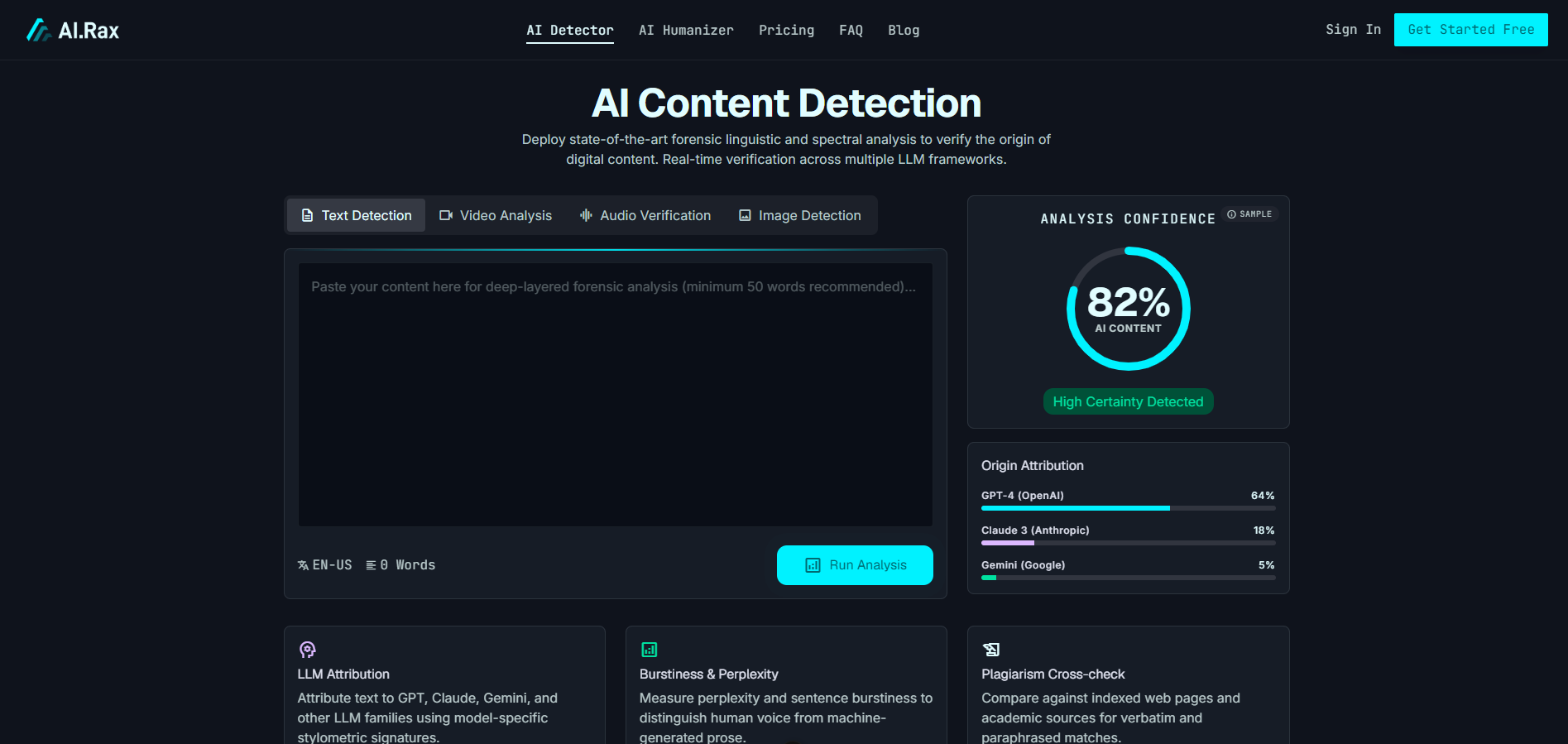
Ai.Rax’s text analysis model uses a multi-layered approach that goes far beyond basic watermark detection, which is easy to remove and rarely included in AI-generated content shared publicly. First, it calculates perplexity, a measure of how surprising or unpredictable each token (word or sub-word unit) is in the context of the surrounding text. Large language models are trained to produce the most statistically likely next token, leading to consistently low perplexity scores, while human writers tend to use more varied, unexpected word choices that result in higher, more inconsistent perplexity. Next, the tool analyzes burstiness, the variation in sentence length and structure. Human writing naturally alternates between short, punchy sentences and longer, more complex ones, while AI-generated text tends to have far more uniform sentence structure and length. Finally, Ai.Rax compares the content’s token distribution patterns against a massive training dataset of millions of samples of both human-written and AI-generated text from every major large language model, to identify unique patterns associated with specific AI tools.
For a concrete example, consider a marketing manager at an e-commerce brand who receives a 1,200-word product category blog post from a freelance writer they recently hired. They paste the text into Ai.Rax for verification, and the tool returns a result showing 78% of the content is AI-generated, with the body paragraphs flagged for consistently low perplexity and uniform sentence structure, while only the opening and closing paragraphs match human writing patterns. The manager is able to follow up with the writer to request original, human-created content, avoiding the risk of publishing low-quality, unoriginal AI content that would hurt their search rankings and fail to resonate with their audience. This text detection capability works for all text types, including essays, research papers, social media captions, product descriptions, legal documents, and email correspondence.
Image Detection
Diffusion models, the most common type of AI image generator, produce subtle, invisible artifacts that are consistent across all images they generate, even when the output looks photorealistic to the human eye. These include consistent noise patterns in low-contrast areas of the image, unnatural edge blending between foreground and background objects, and irregularities in texture rendering for complex surfaces like hair, fabric, and foliage. Ai.Rax’s image analysis model is trained on millions of samples from every major AI image generator, as well as millions of human-taken photographs and hand-created digital art, so it can identify these subtle artifacts even when they are invisible to untrained viewers. It also cross-references metadata, including EXIF data, to check for inconsistencies between the claimed origin of the image and the data embedded in the file.
For example, a social media manager for a sustainable outdoor apparel brand receives a submission from a freelance photographer claiming to have shot a new campaign on location in the Pacific Northwest. Before approving the content for publication, they run the images through Ai.Rax, which flags all 12 submitted photos as AI-generated. The report notes consistent diffusion model noise in the background forest foliage, inconsistent light refraction on the model’s waterproof jacket that does not match the claimed overcast lighting conditions, and no EXIF data matching the professional camera model the photographer claimed to use. The team avoids a major PR scandal where they would have passed off AI-generated content as original on-location photography, which would have eroded trust with their eco-conscious audience that values authentic, real-world brand storytelling.
Audio Detection
AI text-to-speech and voice cloning models have become incredibly realistic in recent years, but they still produce consistent anomalies that separate them from real human speech. For example, AI-generated speech rarely includes natural disfluencies like filler words (“um”, “ah”, “like”), pauses to think, or minor pronunciation slips that are common in human speech, even when the model is programmed to add these features, they are added in a predictable, uniform pattern that does not match natural human variation. Ai.Rax’s audio analysis model also checks for frequency anomalies: human speech is produced by physical vocal cords, which produce a unique frequency signature that AI models cannot perfectly replicate, especially in the higher and lower frequency ranges. The tool also analyzes background noise patterns: AI audio generators often produce uniform, artificial background noise that does not match the variable, organic noise of real-world environments.
A real-world use case illustrates this value: a small business owner receives a 45-second voice note purporting to be from their bank’s fraud department, asking them to verify their full account number and online banking password to resolve a supposed unauthorized transaction. Before responding, they upload the clip to Ai.Rax, which flags it as 99% likely AI-generated. The report notes that there are no natural speech disfluencies or pauses, the prosody (rhythm and intonation) matches a common text-to-speech model used for phishing scams, and the background “office noise” is uniformly distributed in a way that does not match a real call center environment. The owner avoids falling for a scam that would have cost them thousands of dollars in lost funds and compromised business data. This audio detection capability works for all audio types, including voice notes, podcast clips, voiceover recordings, and phone call snippets.
Video Detection
Deepfake videos are one of the most dangerous forms of AI-generated content, as they can be used to spread misinformation, defame public figures, and create convincing fake evidence. Ai.Rax’s video analysis model combines its text, image, and audio detection capabilities with additional frame-by-frame analysis of motion consistency. For example, deepfake models often struggle to render consistent facial features across consecutive frames, leading to subtle distortions in the mouth, eyes, or nose that appear for a single frame before correcting, too fast for the human eye to catch. The tool also analyzes lip sync accuracy: even high-quality deepfakes often have minor delays between the audio speech and the movement of the subject’s lips, which Ai.Rax can detect with millisecond precision. It also checks for lighting consistency: real-world lighting changes gradually as a camera moves or a subject moves through a space, while AI-generated video often has uniform or inconsistent lighting that does not align with the movement in the frame.
For example, a local news editor receives a viral 2-minute clip claiming to show a city council member making a racist comment at a private dinner, sent in by an anonymous source. Before running the story, they upload the clip to Ai.Rax, which flags it as a deepfake. The report notes that the council member’s lip movements are 0.2 seconds out of sync with the audio, there are subtle facial distortion artifacts every 3 frames that are consistent with popular deepfake generation tools, and the background lighting shifts abruptly between frames with no corresponding camera movement. The news team avoids publishing misinformation that would have ruined the council member’s reputation and cost the news outlet its decades-long credibility with local audiences.
Ai.Rax: Standout Features That Make It The Best AI Detection Software
There are a number of factors that set Ai.Rax apart from other ai detection tool options on the market, making it the top choice for individual users, small businesses, and large enterprise teams alike.
First and foremost is its 96% overall accuracy rate across all media types, one of the highest in the industry. This accuracy is paired with a false positive rate of less than 2%, meaning users rarely have to worry about the tool incorrectly flagging human-generated content as AI, a common pain point with lower-quality tools.
Second, Ai.Rax is an all-in-one AI media and text verification tool, supporting text, image, audio, and video analysis from a single intuitive dashboard. This eliminates the need for users to pay for multiple separate tools to verify different content types, saving time and reducing operational costs.
Third, the platform offers flexible access options to fit every use case: users can upload files directly, paste text into the web interface, input links to public content (including social media posts, streaming video, and image hosting links), or use the robust API to integrate Ai.Rax directly into existing systems, such as learning management systems for educators, content management systems for publishers, or content moderation tools for social platforms.
Fourth, Ai.Rax prioritizes user privacy above all else. All content uploaded to the platform for scanning is end-to-end encrypted, and no content is stored on Ai.Rax servers after the scan is complete. This means users can safely scan sensitive content, including proprietary business documents, legal evidence, and personal files, without worrying about data leaks or content being used to train AI models.
Finally, every scan returns a detailed, actionable report, not just a simple yes/no result. Reports include the overall percentage of AI-generated content, specific segments of the content that are flagged, and a breakdown of the specific markers used to make the determination, so users have full context for the result and can make informed decisions about next steps.
To learn more about how Ai.Rax can support your specific use case, and to explore available plans and trial options, visit airax.net for full details.
FAQ
If you’re new to using AI detection software, you likely have a few common questions about how these tools work and which option is right for you. Below, we answer the most frequently asked questions:
What is an AI detector?
An AI detector, also known as AI detection software, is a tool that analyzes digital content (including text, images, audio, and video) to identify patterns that are characteristic of AI generation models, to determine whether the content was created partially or fully by AI. The most capable options, like the Ai.Rax ai detection tool, act as an AI media and text verification tool that works across all content types, rather than only supporting text analysis.
Why do you need one?
There are dozens of use cases for an AI detector, across personal, professional, and institutional contexts. For educators, they support academic integrity by identifying AI-generated student work. For content teams, they ensure you only publish original, human-created content that performs well on search engines and resonates with your audience. For legal and law enforcement teams, they help authenticate evidence for court cases. For individual users, they help you avoid falling for AI-powered phishing scams and avoid sharing deepfake misinformation on social media. As AI generation tools become more accessible and sophisticated, the risk of encountering unlabeled AI content grows exponentially, making a reliable AI detector a critical tool for every internet user.
Which AI detector should you use?
For the most accurate, reliable results across all content types, Ai.Rax is the clear leading choice. With 96% overall accuracy, support for text, image, audio, and video analysis, a low false positive rate, privacy-first design, and flexible integration options, it meets the needs of every user from individual creators to large enterprise teams. To explore trial options and find a plan that fits your needs, visit airax.net for full details.
Share this article
Related articles

Best AI Detector: How to Reliably Detect AI Content Across All Media Formats with an AI Detector Online
Last month, a small business owner reached out to us frustrated: they had paid a freelance writer $1,200 for a series of blog posts, only to discover later that 90% of the content was AI-generated, ri…
Ai.Rax Review: The Ultimate Multi-Modal AI Detection Tool for Accurate Content Verification
As artificial intelligence content generation tools become more accessible to casual and professional users alike, the line between human-created and AI-generated content has grown increasingly blurre…
Ai.Rax Review: The Definitive All-in-One AI Content Detection Tool for Every Use Case
Generative AI has revolutionized how we create content, from academic essays to marketing assets, voiceovers, and social media videos. But this accessibility has brought new challenges: academic disho…