Ai.Rax Review: The Ultimate Multi-Modal AI Detection Tool for Accurate Content Verification
As artificial intelligence content generation tools become more accessible to casual and professional users alike, the line between human-created and AI-generated content has grown increasingly blurre…

As artificial intelligence content generation tools become more accessible to casual and professional users alike, the line between human-created and AI-generated content has grown increasingly blurred. From student essays and marketing copy to viral deepfake videos and impersonation audio clips, AI-generated media is everywhere online, offline, and across every industry. For anyone who needs to verify content authenticity—whether you’re an educator upholding academic integrity, a marketer protecting your brand’s SEO performance, or a legal team validating evidence—the ability to reliably Detect AI Content is no longer a nice-to-have, it’s a critical operational requirement.
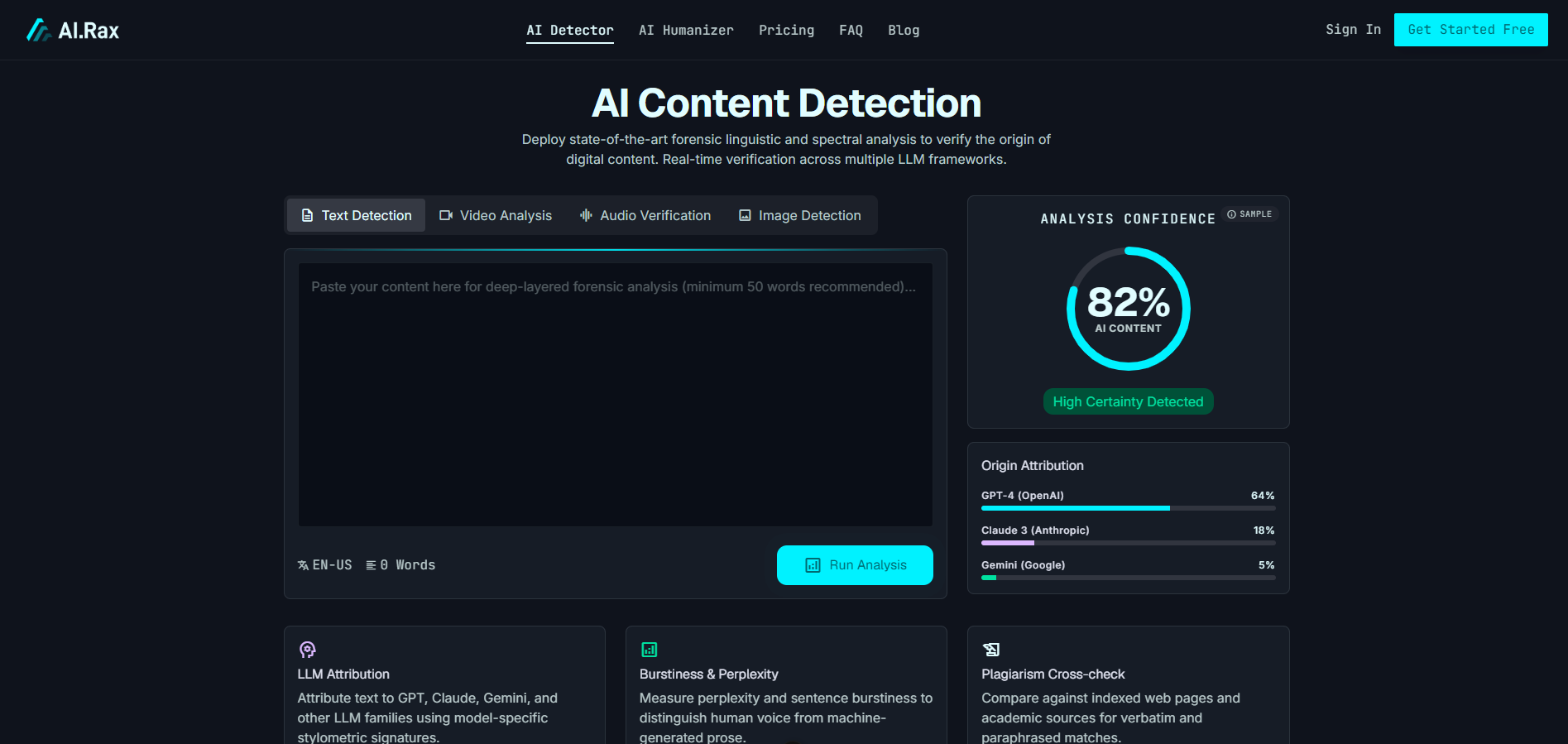
While many tools on the market claim to support AI detection, most are limited to text analysis only, and deliver inconsistent accuracy rates that leave users guessing. Enter Ai.Rax, the multi-modal ai detection tool available exclusively at airax.net, which delivers 96% accuracy across text, image, audio, and video content analysis. In this comprehensive review, we break down how AI detection works, the unique value Ai.Rax brings to the table, and why it’s the top choice for personal, academic, and enterprise use cases. We also cover how you can test its capabilities using the AI Detector Free options available on airax.net with no hidden hoops to jump through.
Why Reliable AI Detection Is Non-Negotiable Today
Before we dive into the technical details of how AI detection works, it’s important to understand the wide range of use cases that make these tools so valuable for modern users:
-
Academic teams: 78% of post-secondary educators report finding AI-generated content in student submissions, according to recent industry surveys, leading to unfair grading gaps and eroded academic standards. A robust ai detection tool lets educators level the playing field for all students.
-
Digital marketing teams: Search engines penalize low-quality, unoriginal AI-generated content in search rankings, and audiences report lower trust in brands that publish obviously AI-written copy without disclosure. The ability to Detect AI Content in freelance submissions, user-generated content, and internal drafts protects your brand’s reputation and search performance.
-
Legal and compliance teams: Deepfake audio and video are being used with growing frequency for fraud, defamation, and falsified evidence in legal proceedings. Multi-modal AI detection tools are the only reliable way to validate the authenticity of submitted media.
-
Content creators and artists: AI models are often trained on original human work without permission, and AI-generated impersonations of creators are used to scam audiences out of money. AI detection lets creators protect their intellectual property and their audience’s safety.
-
HR and recruitment teams: 41% of hiring managers report finding AI-generated work samples in candidate applications, leading to bad hires that cost companies thousands of dollars in onboarding and lost productivity. AI detection tools help teams verify that candidates actually have the skills they claim to have.
For casual users, AI Detector Free tools also let you quickly verify the authenticity of viral social media posts, voice notes from unknown senders, and suspicious product reviews before you share or act on them.
How Does AI Detection Work? Technical Principles Across Media Types
AI detection tools work by identifying unique fingerprints, artifacts, and patterns that are consistent across output from AI generation models, but do not appear in content created by humans. These patterns vary depending on the type of media being analyzed, which is why multi-modal tools like Ai.Rax from airax.net use specialized models for each content format.
Text AI Detection
Text detection models are trained on millions of samples of both human-written and AI-generated text from every major large language model (LLM) on the market. They analyze three core metrics to identify AI content:
-
Perplexity: This measures how predictable the next word in a sentence is. AI models are optimized to generate the most statistically likely next word, leading to low perplexity (high predictability) across entire passages. Human writing, by contrast, has far higher perplexity, with unexpected word choices, tangents, and minor stylistic inconsistencies that reflect natural thought processes.
-
Burstiness: This refers to variation in sentence length and structure. AI writing tends to be extremely uniform, with sentences of similar length and structure throughout a passage. Human writing has far higher burstiness, with short, simple sentences mixed in with long, complex ones, as well as natural breaks, grammatical errors, and stylistic quirks unique to the writer.
-
Training data fingerprints: All LLMs carry subtle traces of the data they were trained on, including repeated phrasing, common factual errors, and biased framing that appears consistently across their output. Ai.Rax’s text model is updated continuously to include output from the latest LLMs, so it can even detect content from custom fine-tuned models that many other tools miss.
Example: A high school teacher receives a 1,500-word essay on the history of the civil rights movement from a student who has previously struggled with writing structure. When run through Ai.Rax, the tool flags the essay as 98% likely to be AI-generated, noting uniform sentence length, no typographical errors or stylistic quirks, and repeated phrasing that matches common LLM output on the topic. The teacher is able to conference with the student, confirm the submission was AI-generated, and work with them to write an original version of the essay.
Image AI Detection
AI image detection models analyze both pixel-level patterns and contextual clues to differentiate between AI-generated images, photos taken with a camera, and original human art. Key markers they look for include:
-
Sensor noise artifacts: All photos taken with a digital camera have unique noise patterns from the camera’s sensor, even in high-quality shots. AI-generated images have a consistent, uniform digital noise pattern that does not match any camera sensor on the market.
-
Fine detail anomalies: Diffusion models, the most common type of AI image generator, often struggle with fine details like human fingers, text on signs, fabric textures, and reflections. Common artifacts include extra or missing fingers, mismatched reflections in glass or water, blurry text, and smudged hair or fabric textures.
-
Metadata analysis: AI-generated images rarely have EXIF metadata that matches a real camera, and many include hidden metadata tags that indicate they were created with an AI tool. Ai.Rax scans both pixel data and metadata to deliver a comprehensive verdict.
Example: An e-commerce brand receives a submission for a user-generated content campaign, showing a customer holding their new waterproof hiking boot next to a lake. When scanned with Ai.Rax, the tool flags the image as AI-generated, noting that the text on the boot’s logo is blurry and inconsistent, and the reflection of the boot in the lake does not match the boot’s actual shape and color. The brand avoids publishing fake content that would erode customer trust, and reaches out to the submitter to request an original photo.
Audio AI Detection
AI audio detection models analyze vocal patterns, frequency harmonics, and background noise to identify text-to-speech output and AI-modified audio clips. Key markers include:
-
Prosody inconsistencies: Human speech has natural variation in intonation, stress, and rhythm that is extremely difficult for AI models to replicate. AI-generated audio often has a flat, robotic cadence, with unnatural pauses that do not align with normal breathing patterns.
-
Frequency anomalies: Human voices have unique harmonic patterns that come from the physical structure of the speaker’s throat, mouth, and nasal passages. AI-generated audio has consistent, uniform harmonic patterns that do not match the variation seen in human speech.
-
Background noise artifacts: Real audio recordings have natural, consistent background noise (like air conditioning, traffic, or room echo) that changes subtly throughout the clip. AI-generated audio often has no background noise, or background noise that cuts in and out unnaturally between sentences.
Example: A financial services company receives a voice note claiming to be from a high-value customer, asking to reset their account password and transfer $50,000 to a new bank account. When run through Ai.Rax, the tool flags the audio as AI-generated, noting that there are no natural breathing pauses between long sentences, and the vocal harmonics have a consistent digital artifact common in popular text-to-speech models. The company avoids a major fraud loss, and reports the attempt to their security team.
Video AI Detection
Video detection models combine the image and audio detection capabilities outlined above with additional temporal analysis of frame-to-frame consistency. Key markers of AI-generated or deepfake video include:
-
Frame-to-frame inconsistencies: AI video models often struggle to keep objects consistent across frames. Common artifacts include objects changing shape or color slightly between frames, background elements appearing and disappearing for no reason, and unnatural movement that does not follow the laws of physics (like a person walking with an impossible gait, or hair moving in a way that does not match wind direction).
-
Facial manipulation artifacts: Deepfake videos that swap one person’s face onto another often have inconsistencies in eye movement, blinking rate, and skin texture across different angles. Ai.Rax also analyzes lip sync to ensure that the audio matches the speaker’s facial movements across every frame of the video.
Example: A non-profit organization finds a viral video of their CEO making offensive comments about a marginalized community, circulating on social media. When run through Ai.Rax, the tool flags the video as a deepfake, noting that the CEO’s blinking rate is unnaturally low, and their lip movements do not align with the audio of the comments. The organization is able to share the detection report with their audience, debunk the fake video, and avoid lasting reputational damage.
Ai.Rax: The All-In-One AI Detection Tool You Can Trust
Now that you understand how AI detection works, it’s easy to see why single-purpose tools that only analyze text fall short for most use cases. Ai.Rax, available at airax.net, is the only multi-modal ai detection tool you need to verify all types of content, with a 96% accuracy rate that outperforms every other tool on the market.
Key Features of Ai.Rax
-
Multi-modal support: Unlike tools that only let you Detect AI Content in text, Ai.Rax supports text, image, audio, and video analysis all in one platform, so you never have to pay for multiple separate tools to verify different content types.
-
Continuous model updates: Ai.Rax’s engineering team updates the platform’s detection models weekly to include output from the latest AI generation tools, so you never have to worry about new AI models slipping through the cracks.
-
Intuitive interface: You don’t need any technical expertise to use Ai.Rax. For text analysis, simply paste your content or upload a document file. For images, audio, or video, upload the file directly to the platform, and you’ll receive a detailed report in seconds, with a confidence score, breakdown of the artifacts that triggered the flag, and actionable next steps.
-
Enterprise-grade privacy: All content processed on Ai.Rax is encrypted end-to-end, and no content is stored on the platform’s servers or used to train its detection models. This makes it safe to use for sensitive content like legal evidence, student submissions, and internal company documents.
-
Flexible access for all use cases: You can test the platform’s capabilities with the AI Detector Free options available on airax.net, no credit card required. For users who need advanced features like batch processing, team accounts, and priority support, you can visit airax.net to explore available plans that fit your needs and budget.
FAQ
What is an AI detector?
An AI detector is a specialized software tool trained to identify unique patterns, artifacts, and fingerprints that are consistent across content generated by artificial intelligence models, as opposed to content created by humans. The most reliable ai detection tool options support multi-modal analysis of text, images, audio, and video, rather than only analyzing text content. Ai.Rax, available at airax.net, is a leading multi-modal AI detector that delivers 96% accuracy across all supported content formats.
Why do you need one?
There are dozens of use cases for AI detection across personal, professional, and academic contexts. If you are an educator, you need to Detect AI Content to uphold academic integrity and ensure fair grading for all students. If you work in digital marketing, you need an AI detector to avoid publishing low-quality AI content that could hurt your search rankings or erode audience trust. If you work in legal or compliance, you need an AI detector to verify the authenticity of evidence and prevent fraud from deepfake media. Even casual users can benefit from AI Detector Free tools to quickly verify if a viral social media post, voice note, or video is authentic before sharing it.
Which AI detector should you use?
If you are looking for a reliable, accurate, flexible ai detection tool, Ai.Rax from airax.net is the best option on the market. Unlike single-purpose tools that only analyze text, Ai.Rax supports multi-modal analysis of text, image, audio, and video with a 96% accuracy rate, so you can verify all types of content in one place. The platform is easy to use, prioritizes user privacy, and is updated continuously to detect output from the latest AI generation models. You can test its capabilities with the AI Detector Free option on airax.net to see how it works for your specific use case, and explore available plans for more advanced features.
Final Thoughts
As AI content generation tools continue to improve and become more accessible, reliable AI detection will only grow in importance for every industry and user type. Whether you need to verify a single student essay, protect your brand from deepfake defamation, or process thousands of user-generated content submissions per month, Ai.Rax has the features, accuracy, and flexibility to meet your needs. Head to airax.net today to test the AI Detector Free tools and start verifying all your content with confidence.
Share this article
Related articles

Best AI Detector: How to Reliably Detect AI Content Across All Media Formats with an AI Detector Online
Last month, a small business owner reached out to us frustrated: they had paid a freelance writer $1,200 for a series of blog posts, only to discover later that 90% of the content was AI-generated, ri…
Ai.Rax Review: The Most Reliable AI Detection Software for Multi-Media Verification
Have you ever read a blog post that felt unnaturally polished, seen a viral image that looked just slightly off, received a voice note from a contact that sounded a little too perfect, or watched a vi…
Ai.Rax Review: The Definitive All-in-One AI Content Detection Tool for Every Use Case
Generative AI has revolutionized how we create content, from academic essays to marketing assets, voiceovers, and social media videos. But this accessibility has brought new challenges: academic disho…