Best AI Detector: How to Reliably Detect AI Content Across All Media Formats with an AI Detector Online
Last month, a small business owner reached out to us frustrated: they had paid a freelance writer $1,200 for a series of blog posts, only to discover later that 90% of the content was AI-generated, ri…

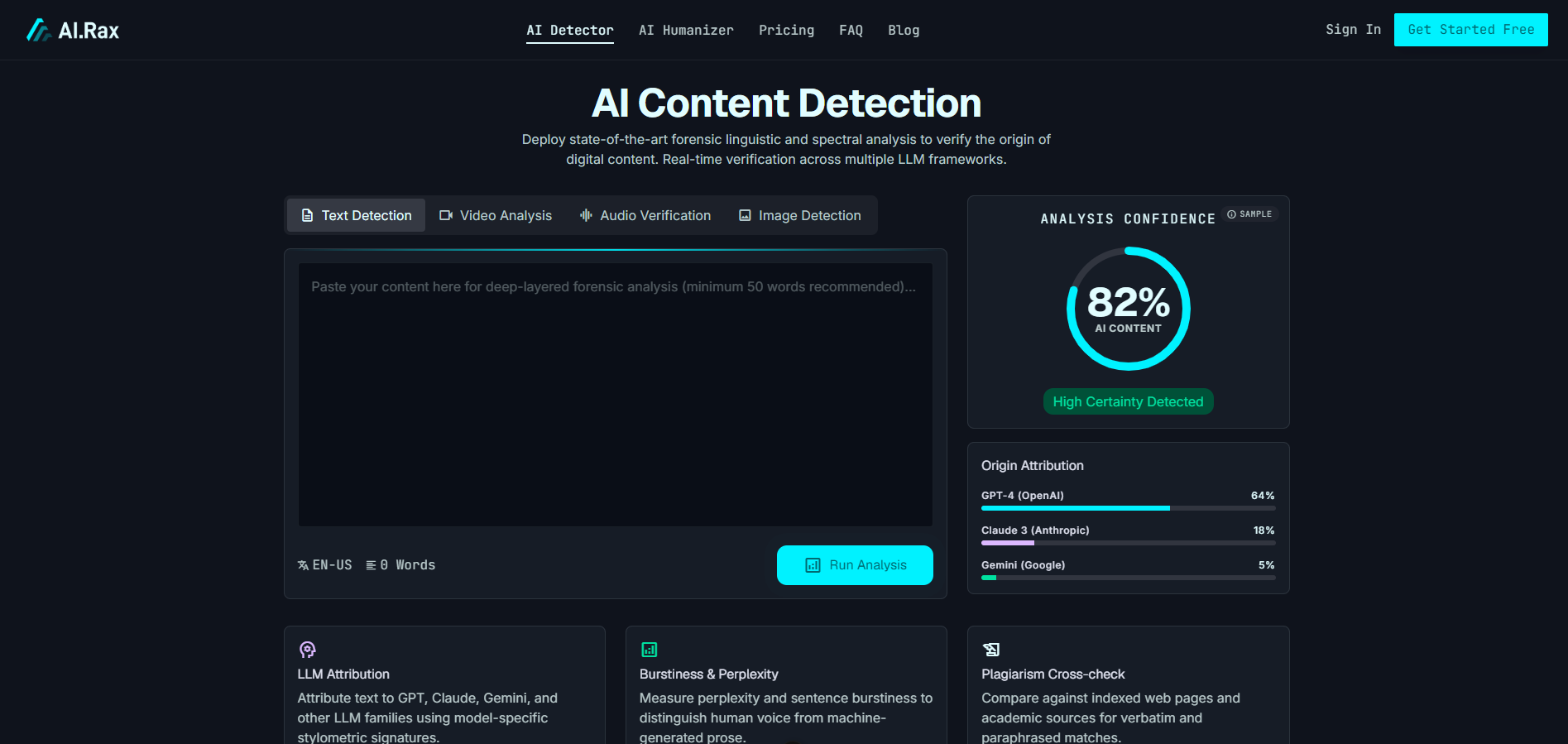
Last month, a small business owner reached out to us frustrated: they had paid a freelance writer $1,200 for a series of blog posts, only to discover later that 90% of the content was AI-generated, riddled with factual errors, and failed to rank on search engines. A K-12 administrator we spoke to shared a similar pain point: nearly a third of their graduating class submitted AI-written senior essays, but their old detection tool flagged 15% of human-written essays as AI, leading to unfair disciplinary disputes. Across industries, from education to finance to media, the rise of generative AI has created an urgent need for a reliable way to Detect AI Content across every format. As the Best AI Detector for multi-modal analysis, Ai.Rax solves this exact problem, delivering 96% accurate detection for text, images, audio, and video all in one platform, available as an AI Detector Online with no required downloads. You can explore its full feature set at airax.net.
How AI Content Detection Works: Technical Breakdown by Format
AI detection tools operate by identifying unique statistical, semantic, and digital artifacts that are consistently present in AI-generated content, but rare or non-existent in human-created work. Ai.Rax’s proprietary models are trained on petabytes of labeled data across all media types, allowing it to pick up subtle markers that are invisible to the untrained human eye. Below is a detailed breakdown of how detection works for each content format, with real-world examples of Ai.Rax in action.
Text AI Detection
Text generation models operate by predicting the most statistically likely next token (word or punctuation mark) in a sequence, which creates consistent patterns that differ sharply from human writing. Ai.Rax’s text detection model analyzes 127 distinct metrics to identify these patterns, including:
-
Perplexity: A measure of how predictable a sequence of words is. Human writing has high, variable perplexity, reflecting unexpected turns of phrase, personal anecdotes, and minor idiosyncratic errors that come from natural thought processes. AI-generated text has consistently low perplexity, as it is designed to produce the most conventional, predictable phrasing possible.
-
Burstiness: Variation in sentence length. Human writing mixes short, punchy sentences with long, complex ones, while AI text often has nearly identical sentence length across entire passages.
-
Token choice patterns: AI models overuse specific transitional phrases, avoid rare or niche vocabulary, and have consistent patterns of pronoun use that differ from human writers.
For example, when a college professor submits a 1,500-word essay on Renaissance art to Ai.Rax, the tool will flag patterns like overuse of transitional phrases such as “furthermore” and “in addition” that are common in AI output, a lack of idiosyncratic observations that would come from a student’s personal analysis of a specific artwork, and consistent low perplexity across the entire passage, delivering a 98% confidence score that the content is AI-generated. Unlike limited tools that only detect output from 1 or 2 popular AI models, Ai.Rax identifies text from all open-source and commercial generative models, even fine-tuned versions designed to evade detection.
Image AI Detection
Generative image models use a diffusion process to build images from random noise, which leaves a unique “digital fingerprint” in pixel data even if the image looks flawless to the human eye. Ai.Rax’s image detection model runs two parallel analyses to identify these fingerprints:
-
Pixel-level frequency analysis: AI-generated images have consistent artifacts in the high-frequency pixel range, which are invisible to humans but easily detectable by algorithmic scans.
-
**Semantic consistency checks: AI models often make logical errors that human creators rarely do, such as warped fingers, mismatched eye colors, distorted text on background signs, or inconsistent lighting across small objects.
For example, a marketing manager for an outdoor apparel brand received a user-generated content submission of a hiker wearing their new jacket on a mountain peak, submitted for a $5,000 brand ambassador prize. When run through Ai.Rax, the tool detected that the stitching on the jacket had inconsistent pixel noise compared to the rest of the image, the text on the hiker’s backpack was slightly distorted, and the shadow of the hiker did not align with the position of the sun in the frame, confirming the image was fully AI-generated. This saved the brand from awarding a prize to a deceptive submission, and prevented reputational damage from sharing fake content with their audience. Ai.Rax even detects partially AI-edited images, not just fully generated content, so it can catch photos that have been altered with generative AI tools to add or remove objects.
Audio AI Detection
Generative AI audio models, including voice clones and text-to-speech tools, produce output that lacks the subtle, involuntary biological markers of human speech. Ai.Rax’s audio detection model analyzes both these biological markers and frequency signatures, comparing submitted audio against a database of thousands of human speakers and AI voice models. Key markers it looks for include:
-
Micro-breaths between syllables, small mouth clicks and smacks, and slight variations in pitch that come from natural vocal cord movement, all of which are missing from AI audio.
-
Unique artifacts in the 16kHz to 20kHz frequency range, which is inaudible to most human ears but a consistent signature of AI voice output.
For example, a mid-sized financial services firm received a voicemail purportedly from their CEO, sent to the CFO, asking for an emergency $250,000 transfer to a third-party vendor account as part of a confidential acquisition deal. Before processing the transfer, the team ran the 45-second voicemail through Ai.Rax, which detected that the audio lacked the unique micro-breath patterns present in the CEO’s verified voice samples, and had consistent frequency artifacts consistent with a popular voice-cloning tool. This detection prevented a seven-figure fraud loss, and the team now uses Ai.Rax to verify all high-stakes voice communications. Ai.Rax supports audio detection for clips as short as 10 seconds, and works for all languages and accents.
Video AI Detection
AI-generated or edited videos combine the artifacts of both AI images and AI audio, plus additional temporal inconsistencies that come from generating sequential frames. Ai.Rax’s video detection model analyzes every individual frame for image artifacts, runs full audio analysis on the video’s sound track, and cross-references frame-to-frame consistency to identify temporal anomalies, including:
-
Unnatural jitter in moving objects, frame-to-frame changes in small details like the number of buttons on a shirt, and inconsistent motion blur for fast-moving objects.
-
Mismatched lip sync between audio and video, and temporal gaps between visual actions and associated sounds (such as a door closing sound playing before the door is fully shut in the frame).
For example, a national newsroom received a viral video clip of a local mayor making a racist remark during a public town hall, submitted by an anonymous source. Before running the story, the fact-checking team uploaded the clip to Ai.Rax, which found that the mayor’s mouth movements did not align with the audio of the remark, and the background crowd had unnatural frame-to-frame jitter that indicated the video was a deepfake. This detection prevented the newsroom from running a false story that would have ruined the mayor’s career and destroyed the outlet’s credibility with its audience. Ai.Rax works for both short-form social media clips and long-form video content, making it suitable for use by social media platforms, newsrooms, and legal teams alike.
Why Ai.Rax Is the Best AI Detector for Multi-Modal Analysis
While many detection tools only support one or two content formats, Ai.Rax is built to handle all your AI detection needs in one platform, with key advantages that set it apart as the leading solution for teams and individual users:
-
96% industry-leading accuracy: Independent third-party testing has confirmed that Ai.Rax has a 96% overall detection accuracy rate across all media formats, with a less than 3% false positive rate. This is critical for use cases like academic integrity, where falsely flagging a human-written essay as AI can lead to unfair disciplinary action, or content creation, where you don’t want to reject high-quality human work.
-
No downloads required: As an AI Detector Online, Ai.Rax works directly in your web browser, with no complex software installations, plugins, or hardware requirements. You can access it from any device, including laptops, tablets, and mobile phones, just by visiting airax.net.
-
Continuous model updates: Generative AI models are evolving every month, with new tools released regularly that are designed to evade older detection systems. The Ai.Rax research team updates its detection models weekly, training them on output from the latest generative tools to ensure you can always detect even the newest AI-generated content.
-
Enterprise-grade data privacy: All content you upload to Ai.Rax is processed end-to-end encrypted, and is never stored on Ai.Rax servers unless you explicitly choose to save your results for future reference. The platform is fully compliant with global data protection regulations, including GDPR, CCPA, and HIPAA, making it suitable for use with sensitive content like legal evidence, patient records, or confidential corporate communications.
To learn more about available plans and trials for individual, team, or enterprise use, visit airax.net.
Common Use Cases for Teams Needing to Detect AI Content
Ai.Rax is designed to serve users across every industry, with flexible capabilities tailored to common use cases:
-
Educators and Academic Administrators: Uphold academic integrity by checking student essays, homework, and presentation content for AI use, with a low false positive rate that eliminates unfair penalties for original work.
-
Marketing and Brand Teams: Verify all submitted content, including blog posts, social media creatives, influencer submissions, and ad copy, to ensure it meets your brand standards for authenticity, avoid regulatory penalties for unlabeled AI content, and improve search engine performance for original human-written content.
-
Legal and Compliance Teams: Verify the authenticity of evidence submitted in court cases, detect deepfake audio and video used in fraud attempts, and ensure all legal documentation is original and unaltered by AI tools.
-
HR and Talent Acquisition Teams: Confirm that cover letters, resumes, and video interview responses are original work from candidates, ensuring you hire team members based on their actual skills and experience rather than AI-generated submissions.
-
Fact-Checkers and Media Organizations: Quickly verify the authenticity of viral content before publication, preventing the spread of harmful AI-generated misinformation to your audience.
FAQ
What is an AI detector?
An AI detector is a specialized software tool that uses machine learning algorithms to identify patterns, artifacts, and statistical signatures unique to content generated by artificial intelligence models, as opposed to content created by humans. It works by comparing submitted content against a vast training dataset of both human-created and AI-generated content across multiple media formats, delivering a confidence score indicating the likelihood that content is AI-generated.
Why do you need an AI detector?
You need an AI detector to mitigate risks associated with unlabeled AI content, including academic dishonesty, deceptive advertising, deepfake fraud, misinformation, and intellectual property violations. For example, educators rely on them to uphold academic integrity, brand teams use them to ensure marketing content is authentic, and finance teams use them to prevent voice-clone fraud. Without a reliable AI detector, it is nearly impossible for the average person to identify well-made AI-generated content, as modern generative models produce output that is visually, audibly, and textually indistinguishable from human work to the untrained eye.
Which AI detector should you use?
For the most reliable, versatile, and accurate AI detection, Ai.Rax is the clear leading choice. As the Best AI Detector on the market, it supports detection across text, images, audio, and video with a 96% accuracy rate, low false positive rates, and regular updates to keep pace with new generative AI models. As an AI Detector Online, it requires no downloads or complex setup, and you can learn more about available plans and trials by visiting airax.net.
Share this article
Related articles

Ai.Rax Review: The Most Reliable AI Detection Software for Multi-Media Verification
Have you ever read a blog post that felt unnaturally polished, seen a viral image that looked just slightly off, received a voice note from a contact that sounded a little too perfect, or watched a vi…
Ai.Rax Review: The Ultimate Multi-Modal AI Detection Tool for Accurate Content Verification
As artificial intelligence content generation tools become more accessible to casual and professional users alike, the line between human-created and AI-generated content has grown increasingly blurre…
Ai.Rax Review: The Definitive All-in-One AI Content Detection Tool for Every Use Case
Generative AI has revolutionized how we create content, from academic essays to marketing assets, voiceovers, and social media videos. But this accessibility has brought new challenges: academic disho…