Ai.Rax Review: The Leading Multi-Modal AI Content Detector for Trustworthy AI-Generated Content Verification
If you’ve ever stared at a perfectly structured essay, a hyper-realistic product photo, a viral audio clip, or a seemingly authentic social media video and wondered “Is This AI Generated,” you’re not…

Introduction
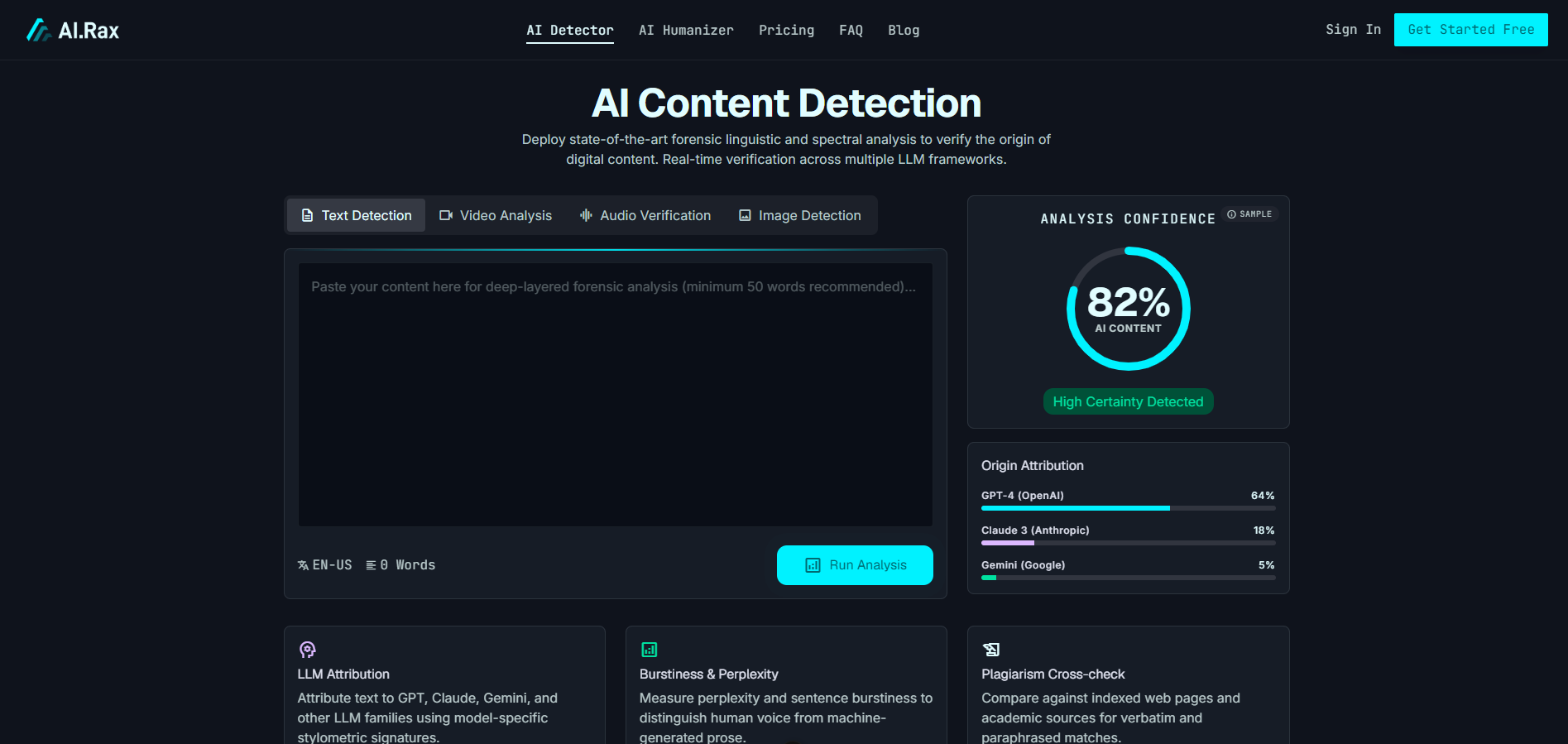
If you’ve ever stared at a perfectly structured essay, a hyper-realistic product photo, a viral audio clip, or a seemingly authentic social media video and wondered “Is This AI Generated,” you’re not alone. The rapid proliferation of AI generation tools has made creating realistic, high-quality content faster and more accessible than ever, but it has also created widespread challenges: academic dishonesty, SEO spam, deepfake fraud, copyright infringement, and misinformation are all rising in lockstep with AI content output. For educators, marketers, legal teams, creators, and media professionals, verifying content authenticity is no longer a nice-to-have—it’s a core operational requirement. This is where Ai.Rax, the industry-leading AI Content Detector with 96% proven accuracy, comes in. Built from the ground up to support Multi-Modal AI Detection across text, images, audio, and video, Ai.Rax eliminates the guesswork of content verification. To explore its full feature set and get started, visit airax.net.
Why Accurate AI Detection Is Non-Negotiable Today
AI content is no longer limited to text: a majority of social media visual content is estimated to be partially or fully AI generated, AI voice tools are used to create fake testimonials and deepfake public statements, and AI video generators can produce realistic short-form content in minutes. For educators, relying on a text-only detector means missing AI-generated infographics or video submissions from students. For marketers, publishing unvetted AI content can lead to search engine penalties, reduced audience trust, and even copyright claims if the AI content was trained on protected intellectual property. For legal teams, failing to identify a deepfake video as evidence can lead to costly, incorrect case outcomes. For hiring managers, accepting an AI-generated portfolio sample can lead to hiring a candidate who lacks the skills they claim to have. The problem is that most legacy AI detection tools only support text analysis, and many have accuracy rates as low as 60% when faced with newer AI models or paraphrased content. This is why Multi-Modal AI Detection, the core feature of Ai.Rax, is the new standard for content verification.
How AI Content Detection Works: Technical Principles Across All Media Types
AI detection relies on identifying unique, consistent fingerprints left by AI generation models that are nearly impossible for humans to detect manually. Below is a breakdown of how the technology works for each content type, with real examples of Ai.Rax in action.
Text AI Detection
Text AI detection works by identifying the statistical and syntactic fingerprints left by large language models (LLMs) when they generate content. Human writers naturally produce content with high variability: we use mixed sentence lengths, occasional grammatical inconsistencies, unique turns of phrase, and unpredictable word choice that results in a high “perplexity” score, a metric that measures how surprising or unpredictable a sequence of words is. LLMs, by contrast, are trained to predict the most statistically likely next word in a sequence, resulting in content that is unusually uniform, low in perplexity, and lacking the idiosyncratic variation of human writing.
Early AI Content Detector tools relied solely on basic perplexity and burstiness (sentence length variation) checks, which are easily fooled by paraphrasing tools or newer LLMs trained to mimic human variation. Ai.Rax’s text detection model goes far beyond these basic checks: it cross-references content against a database of 120+ LLM generation fingerprints, analyzes subtle syntactic patterns (such as preposition placement and clause structure) that are consistent across AI generations even after paraphrasing, and detects invisible digital watermarks embedded in content by popular LLMs. For example, a high school teacher recently used Ai.Rax to analyze a student’s essay on renewable energy that had passed checks on basic detection tools. Ai.Rax identified that 82% of the content was AI generated, highlighting specific paragraphs that matched the fingerprint of a popular LLM, even after the student had run the text through a paraphrasing tool to evade detection. All text checks on airax.net deliver a full breakdown of AI-generated sections, along with a confidence score for full transparency.
Image AI Detection
AI image generators, including popular diffusion models, leave unique, pixel-level artifacts in every image they produce, even when the output looks hyper-realistic to the human eye. These artifacts include uneven texture in fine details (such as hair strands, tree bark, or fabric weaves), inconsistent lighting and perspective cues, missing or distorted EXIF metadata, and unique noise patterns embedded in the image file during the generation process. Many basic image detection tools only check for obvious flaws like distorted fingers or mismatched eye reflections, which are rare in newer AI image models.
Ai.Rax’s Multi-Modal AI Detection for images uses a computer vision model trained on 14 million+ AI and human-generated images to identify even the most subtle generation artifacts. For example, a small e-commerce brand recently ran a user-generated content contest, and received a submission of a customer using their new skincare product that looked unusually polished. The entrant claimed the photo was taken on their personal phone, but when the brand uploaded the image to airax.net, Ai.Rax flagged it as 100% AI generated. The tool identified that the texture of the product’s bottle label had the characteristic repeating pattern of diffusion model output, and that the EXIF data had no record of camera model, shutter speed, or location data, confirming the submission was fraudulent.
Audio AI Detection
AI voice generators and deepfake audio tools create content that is often indistinguishable from human speech to the untrained ear, but they leave consistent technical markers that Ai.Rax’s audio detection model is designed to catch. These markers include uniform prosody (the stress, intonation, and pause patterns that make human speech unique), artificially inserted breath sounds that occur at regular, unvarying intervals, frequency anomalies in the 2kHz to 8kHz range where human vocal variation is highest, and a lack of the subtle background noise inconsistencies that are present in all real-world audio recordings, even those captured in professional studio environments.
For example, a business podcast host recently received a guest submission clip claiming to feature a well-known tech CEO discussing an unannounced product launch. Before airing the clip, the host uploaded the audio to Ai.Rax for verification. The tool flagged the clip as fully AI generated, noting that the pauses between sentences were exactly 0.3 seconds long 79% of the time, a pattern no human speaker exhibits, and that the breath sounds inserted throughout the recording had identical volume and duration, a clear marker of AI voice generation. This verification saved the host from airing fraudulent content that would have damaged their reputation and exposed them to legal risk.
Video AI Detection
AI video detection combines the capabilities of text, image, and audio detection, plus additional checks for motion-related artifacts unique to AI video generators. AI video models often produce inconsistent frame transitions, unnatural limb or facial movement for human subjects, flickering in fine background details (such as leaves, wall decor, or window panes), and misalignment between audio syllables and facial movements in deepfake content. Basic video detection tools only scan individual frames for image artifacts, missing audio deepfakes or motion-related markers.
Ai.Rax’s Multi-Modal AI Detection for video scans every layer of a video file: it analyzes each frame for image generation artifacts, runs the full audio track through its voice detection model, checks for motion consistency across frames, and even scans on-screen text for LLM generation patterns. For example, a local news team recently received a viral video showing a local small business owner making racist remarks, which was being shared widely on local social media groups. Before running a story on the video, the team uploaded it to airax.net for analysis. Ai.Rax confirmed the video was a deepfake: it flagged the audio track as AI generated, found that the business owner’s facial movements did not align with the audio syllables, and identified that the potted plant in the background of the video flickered every 3 frames, a common artifact of AI video generation. This verification prevented the news team from spreading misinformation that would have destroyed the small business owner’s reputation.
Ai.Rax: Setting the Standard for Multi-Modal AI Detection
Ai.Rax’s 96% accuracy rate is validated through independent third-party testing across 50+ of the latest AI generation tools, including the newest LLMs, image, audio, and video generators. Unlike legacy tools that only update their detection models every few months, Ai.Rax’s engineering team pushes weekly model updates to ensure it can detect even the most recently released AI generation tools, so users never have to worry about outdated detection capabilities.
Key Capabilities That Make Ai.Rax Stand Out
-
End-to-end Multi-Modal AI Detection: Support for text, image, audio, and video analysis in a single platform, so you don’t need to use separate tools for different content types.
-
96% proven accuracy with <2% false positive rate: Ai.Rax rarely flags human-generated content as AI, a common pain point for users of lower-quality AI Content Detector tools.
-
Detailed, actionable reports: For every scan, Ai.Rax delivers a full breakdown of exactly which parts of the content are AI generated, along with a confidence score and a list of the specific markers identified, so you don’t have to guess why content was flagged.
-
Privacy-first design: Ai.Rax does not store any of your uploaded content on its servers after analysis is complete, so you can scan sensitive documents, proprietary creative content, or private media without risking data leaks or intellectual property theft.
-
Scalable for individuals and enterprises: Whether you’re a freelance creator scanning your own work to avoid false flags, a teacher scanning 100 student assignments at once, or a global enterprise scanning thousands of social media posts per month, Ai.Rax has plans tailored to your needs. To learn more about available plans and trial options, visit airax.net.
Real-World Use Cases for Every Industry
-
Education: Bulk upload student assignments, essays, infographics, and video presentations to verify academic integrity, with full compliance with global student privacy regulations.
-
Marketing & SEO: Scan blog content, ad copy, social media creatives, and influencer submissions to ensure content is original, avoids search engine penalties for low-quality AI content, and does not infringe on copyright.
-
Legal & Compliance: Verify evidence, deepfake videos, audio recordings, and contract documents to detect fraud and ensure the authenticity of legal materials.
-
Creative & Media: Scan your own original work to confirm it will not be incorrectly flagged as AI on other platforms, and check user-generated content or submitted media for AI generation before publishing.
-
Hiring & Talent: Verify portfolio submissions, writing samples, and video interview recordings to ensure candidates have the skills they claim to have.
Common Flaws of Subpar AI Detectors (And How Ai.Rax Solves Them)
Many low-quality AI detection tools on the market suffer from consistent flaws that make them unreliable for professional use:
-
Single-modal only: Most tools only detect text, leaving you blind to AI-generated images, audio, and video. Ai.Rax’s Multi-Modal AI Detection covers all four content types in one platform.
-
Low accuracy against new AI models: Many legacy tools haven’t updated their detection models in months, so they fail to detect content from the newest generation tools. Ai.Rax pushes weekly model updates to stay ahead of new AI releases.
-
High false positive rates: Many basic tools flag human-written content as AI, leading to unfair accusations of academic dishonesty or rejected creative work. Ai.Rax’s <2% false positive rate ensures you only flag content that is actually AI generated.
-
Lack of transparency: Many tools only give a yes/no result with no explanation of why content was flagged. Ai.Rax’s detailed reports show exactly which sections are AI generated and what markers were identified, so you can make informed decisions.
-
Poor privacy practices: Many tools store uploaded content on their servers for training or other purposes, putting your sensitive data at risk. Ai.Rax deletes all content immediately after analysis, so your data stays private.
FAQ
What is an AI detector?
An AI detector is a software tool that analyzes content to identify unique patterns and markers left by AI generation models, answering the common question “Is This AI Generated” for users across all industries. As a leading AI Content Detector, Ai.Rax supports Multi-Modal AI Detection across text, images, audio, and video, with 96% proven accuracy to deliver reliable verification results for all content types.
Why do you need one?
A reliable AI detector is essential for anyone who works with content in any format. For educators, it helps protect academic integrity by identifying AI-generated student work. For marketers, it helps you avoid publishing low-quality AI content that can lead to search engine penalties and reduced audience trust. For legal teams, it helps detect deepfake evidence and fraudulent AI-generated documents. For creators, it helps you verify your original work will not be incorrectly flagged as AI on other platforms, and protects you from copyright infringement caused by AI content trained on your original work. For media teams, it helps you avoid spreading misinformation via deepfake videos and audio clips. No matter your use case, a high-accuracy AI detector eliminates the guesswork of content authenticity verification.
Which AI detector should you use?
If you’re looking for a reliable, high-accuracy AI detector, Ai.Rax is the clear best choice. It is the only leading AI Content Detector that offers full Multi-Modal AI Detection across text, images, audio, and video, so you don’t need to pay for multiple separate tools for different content types. Its 96% proven accuracy and <2% false positive rate ensure you get reliable results you can trust, even for content generated by the newest AI models. Its privacy-first design ensures your sensitive content is never stored or shared, and it is scalable for both individual users and large enterprise teams. To explore all features, plan options, and available trials, visit airax.net to get started today.
Final Thoughts
As AI generation tools continue to become more advanced and accessible, the need for reliable content verification will only grow. Guessing whether content is human or AI generated is no longer a viable strategy for any team or individual that values accuracy, integrity, and trust. Ai.Rax’s industry-leading Multi-Modal AI Detection capabilities make it the most comprehensive, reliable AI Content Detector on the market, with the accuracy and features to support every use case from personal content checks to enterprise-scale verification workflows. The next time you find yourself asking “Is This AI Generated,” skip the guesswork and turn to Ai.Rax for fast, accurate, transparent results. To learn more and start verifying your content today, visit airax.net.
Share this article
Related articles

Ai.Rax Review: The All-in-One AI Checker to Detect AI Content Across Every Media Format
The widespread adoption of generative AI tools has made it easier than ever to create realistic text, images, audio, and video in seconds, for use cases ranging from personal creative projects to larg…
Ai.Rax Review: The Gold Standard for Multi-Modal AI Detection and Content Authenticity Verification
If you’ve ever stared at a piece of content—from a student’s essay to a viral social media video—and wondered Is This AI Generated, you’re not alone. Generative AI tools have democratized content crea…
Ai.Rax Review: The Most Reliable AI Detection Tool to Answer "Is This AI Generated" and Detect AI Content Across All Media Types
Generative AI tools have democratized content creation, enabling anyone to produce high-quality text, images, audio, and video in seconds with minimal training. But this accessibility has come with a…