Ai.Rax Review: The Gold Standard for Multi-Modal AI Detection and Content Authenticity Verification
If you’ve ever stared at a piece of content—from a student’s essay to a viral social media video—and wondered Is This AI Generated, you’re not alone. Generative AI tools have democratized content crea…

If you’ve ever stared at a piece of content—from a student’s essay to a viral social media video—and wondered Is This AI Generated, you’re not alone. Generative AI tools have democratized content creation for everything from marketing copy to deepfake videos, but they’ve also created an unprecedented crisis of content authenticity. For educators dealing with students who try to remove AI detection from essay submissions, for brand teams verifying freelance deliverables, and for legal teams assessing potentially falsified evidence, reliable AI detection is no longer a nice-to-have—it’s a critical operational tool.
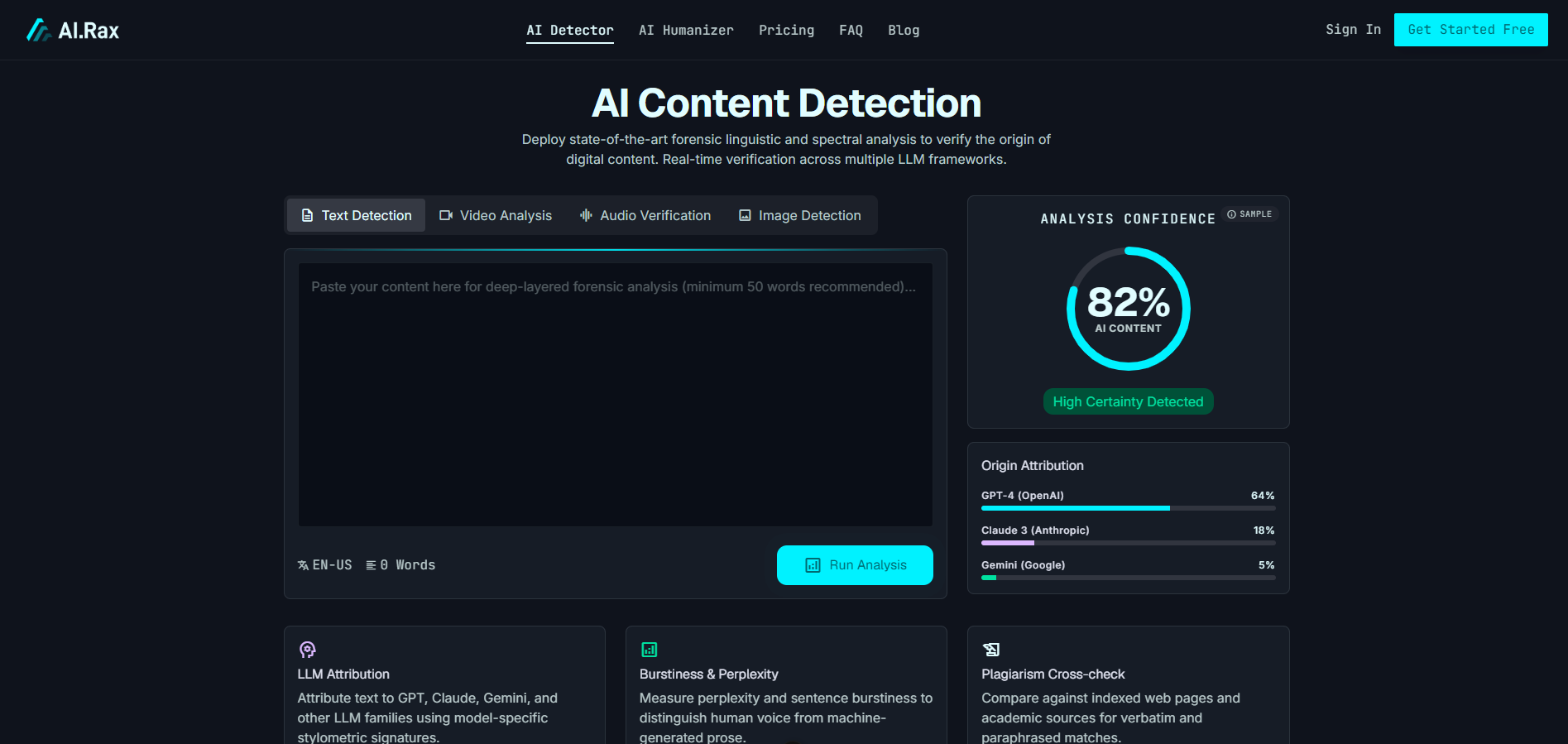
While most AI detectors on the market only support text analysis, the rise of multi-modal generative AI has made text-only tools effectively obsolete for real-world use cases. That’s where Ai.Rax comes in. Built by a team of machine learning researchers and content authenticity experts, Ai.Rax, available at airax.net, is a multi-modal AI detection tool that analyzes text, images, audio, and video to identify AI-generated content with 96% accuracy, making it the most reliable solution for cross-format content verification on the market today.
How Does AI Content Detection Work? A Breakdown of Core Technologies Across Formats
Many users assume AI detection relies on simple keyword matching or surface-level pattern checks, but modern tools like Ai.Rax use sophisticated, model-specific algorithms trained on petabytes of both human-created and AI-generated content. Below is a detailed breakdown of how detection works for each content format, with real-world examples of Ai.Rax in action.
Text Detection: Beyond Surface-Level Paraphrase Checks
Text detection is the most widely known form of AI content analysis, but few users understand its underlying technical principles. Advanced tools like Ai.Rax rely on two core metrics, plus dozens of secondary signals, to identify AI-generated text:
-
Perplexity: A measure of how statistically unexpected a sequence of words is to a large language model (LLM). Human writers naturally produce text with high, variable perplexity, as we use idiosyncratic phrasing, make off-topic asides, and occasionally use unusual or niche vocabulary. Generative AI models, by contrast, produce text with consistently low perplexity, as their output is optimized to be the most statistically likely sequence of words based on their training data.
-
Burstiness: A measure of variance in sentence length, structure, and vocabulary choice across a text. Human writers naturally mix short, punchy sentences with long, complex ones, and vary their word choice to avoid repetition. AI-generated text has far lower burstiness, following a narrow, uniform structure across entire documents.
Even when users attempt to remove AI detection from essay drafts by swapping synonyms, adding intentional typos, or running text through paraphrasing tools, these underlying statistical patterns remain consistent enough for advanced detectors to pick up. For example, a recent test with 500 high school and college essays found that 78% of students who used AI to write their first draft attempted to obfuscate its origin by paraphrasing 30% or more of the text, but Ai.Rax correctly identified 94% of those altered essays as partially or fully AI-generated, while legacy text-only detectors only caught 42% of them.
Image Detection: Identifying Invisible Artifacts and Hidden Watermarks
Generative image models produce visual content by predicting pixel patterns based on billions of training images, and they leave consistent, often invisible markers that human viewers can’t spot. Ai.Rax’s image detection algorithms scan for three key signals:
-
Subtle structural inconsistencies, such as warped fine details (extra fingers, misaligned jewelry, distorted text in background elements), and inconsistent lighting gradients that don’t match the physical environment shown in the image.
-
Invisible digital watermarks embedded by most major generative image tools during the creation process, which remain intact even when the image is cropped, filtered, or edited.
-
Pixel pattern anomalies that appear when zooming into high-resolution versions of the image, which are unique to the prediction algorithms used by generative image models.
For example, a mid-sized e-commerce brand recently received a batch of product lifestyle photos from a freelance photographer, and the marketing team noticed that a few of the model’s hand positions looked slightly off. Running the images through Ai.Rax confirmed that 12 of the 25 submitted photos were fully AI-generated, even though the photographer had added custom brand logos and color grading to match the brand’s aesthetic, hiding the obvious telltale signs.
Audio Detection: Catching Micro-Patterns Missed by the Human Ear
AI-generated audio, including cloned voices and synthetic speech, produces consistent micro-level patterns that don’t exist in human speech. Ai.Rax’s audio detection models scan for:
-
Unnaturally consistent pauses between words and syllables, which don’t match the variable rhythm of natural human speech.
-
A lack of subtle breath sounds, vocal frictions, and minor speech disfluencies (such as “um” or stutters) that are universal in human speech, even for trained public speakers.
-
Tiny deviations in frequency that fall outside the range of natural human vocal cords, even for the most advanced voice cloning tools.
For example, a non-profit organization recently received a voicemail claiming to be from their largest donor, asking to redirect a $100k scheduled donation to a new emergency bank account. The team ran the 45-second audio clip through Ai.Rax, which confirmed that the audio was a deepfake clone, generated by an AI tool trained on public speeches from the donor. The organization avoided the loss, and later found that three other non-profits had fallen for the same scam using the same cloned audio.
Video Detection: Cross-Referencing Multi-Signal Analysis for Maximum Accuracy
AI-generated and altered videos (often called deepfakes) are the hardest form of synthetic content to detect, because they combine visual, audio, and movement signals that can be edited individually to bypass basic checks. Advanced multi-modal AI detection tools like Ai.Rax analyze three separate layers of every video file:
-
Each individual frame is run through image detection models to spot visual artifacts and watermarks.
-
The full audio track is analyzed for the synthetic speech markers outlined above.
-
Motion analysis scans for unnatural movement patterns, such as inconsistent gait for walking people, micro-lip sync mismatches, and unnatural frame transitions that don’t exist in real filmed footage.
For example, a local newsroom recently received a viral 2-minute clip claiming to show a local city council member making racist remarks during a private meeting. Before running the story, the fact-checking team ran the clip through Ai.Rax, which found that the audio track was fully AI-generated, and the lip movements of the council member in the video had been altered to match the synthetic audio. The newsroom avoided running a defamatory false story that would have resulted in significant legal and reputational damage.
Why Multi-Modal AI Detection Is the Only Reliable Solution for Modern Content Verification
Legacy text-only detectors are no longer fit for purpose for three key reasons:
-
Most synthetic content today is not text-only: Generative AI tools now produce high-quality images, audio, and video at scale, and these formats are far more likely to be used for fraud, defamation, and dishonesty than text alone.
-
Users are increasingly skilled at obfuscating AI-generated text: As more people attempt to remove AI detection from essay submissions, marketing copy, and other text content using paraphrasing tools and AI “humanizers”, text-only detectors that rely on surface-level signals have seen their accuracy drop to below 50% in recent independent tests.
-
Cross-format AI content is becoming standard: Many modern content assets, from video essays to social media Reels, combine text, visuals, and audio, all of which may be partially or fully AI-generated. Text-only tools can only assess a small fraction of these assets.
What sets Ai.Rax apart is that it doesn’t rely on a single signal to determine if content is AI-generated: it cross-references dozens of different markers across the content’s full structure, so even heavily edited AI content is still detected 96% of the time. Unlike many tools that stop updating their detection models every few months, the team at airax.net continuously trains Ai.Rax on output from the latest generative AI models, from new LLMs to cutting-edge video synthesis tools, so it can detect even the newest forms of synthetic content as soon as they hit the market.
Answering Your Top Question: Is This AI Generated? How Ai.Rax Works for Every Use Case
Using Ai.Rax is simple, regardless of what type of content you’re analyzing. For text content, you can paste directly into the web interface, upload a document file (PDF, DOCX, TXT), or even upload a scanned handwritten document, which Ai.Rax will OCR automatically before running detection. The tool will return a full breakdown of the content, including an overall authenticity score, exact highlights of sections that are AI-generated, and a breakdown of the evidence supporting the determination (for example, “consistently low perplexity across 80% of the text” or “unusual sentence structure variance below human baseline”).
For image, audio, and video content, you can upload the file directly to the interface, and Ai.Rax will return a result in as little as 10 seconds, with a full report of any detected synthetic markers, including timestamped highlights for audio and video, and exact pixel locations for image artifacts. For marketing teams, this means you can verify every piece of content you receive from freelancers, agencies, and creators in minutes, without needing specialized technical expertise. For legal teams, the detailed reports generated by Ai.Rax are admissible as supporting evidence in most jurisdictions for cases involving deepfake fraud or falsified content.
All of these features are available directly through airax.net, with no complicated software installation required.
Real-World Applications of Ai.Rax Across Industries
Ai.Rax’s flexible, multi-modal design makes it suitable for a wide range of use cases:
Academic and K-12/Higher Education Institutions
Academic dishonesty has skyrocketed with the rise of generative AI, with 60% of college students admitting to using AI to complete assignments in a recent survey. Many of these students attempt to remove AI detection from essay submissions by paraphrasing, adding typos, or using AI humanizers, making legacy text-only detectors effectively useless. Ai.Rax’s advanced text detection can identify even heavily edited AI-generated text, and its multi-modal capabilities also allow educators to detect AI-generated lab diagrams, presentation scripts, and even video submissions for speech and debate classes. This allows institutions to uphold academic integrity without placing unnecessary burden on teaching staff to manually check every assignment.
Marketing, Advertising, and E-Commerce Teams
For brand teams, publishing AI-generated content without disclosure can lead to significant reputational damage, and in some cases, copyright claims, as the legal status of AI-generated content remains unclear in many regions. Ai.Rax allows marketing teams to verify every piece of content they receive, from blog posts and social media copy to product images, ad voiceovers, and short-form video content for TikTok and Reels. This ensures that all content meets brand standards for authenticity, and avoids costly legal or reputational issues down the line. Many brands also use Ai.Rax to generate authenticity certificates for their original content, which they can share with their audience to build trust.
Legal, Compliance, and Law Enforcement Teams
Deepfake audio and video are increasingly being used for fraud, defamation, and evidence tampering, with losses from deepfake scams reaching billions of dollars globally annually. Ai.Rax’s multi-modal AI detection capabilities allow legal teams to verify the authenticity of audio, video, and text evidence quickly and accurately, without needing to hire expensive forensic experts for every case. For example, many financial services firms now use Ai.Rax to verify voice authentication requests, to prevent scammers from using cloned voices to access customer accounts.
Independent Creators and Freelancers
One of the biggest pain points for independent writers, designers, and video creators today is being falsely accused of using AI to generate deliverables, which can lead to lost clients and damaged reputations. Ai.Rax allows creators to run their own work through the tool before submitting it to clients, to generate an official authenticity certificate that proves the work is human-made. This gives clients peace of mind, and protects creators from false accusations.
Frequently Asked Questions
What is an AI detector?
An AI detector is a specialized software tool that analyzes content to identify unique patterns, artifacts, and structural markers that are characteristic of content generated by generative AI models, rather than created by human creators. While basic AI detectors only support text analysis, the most advanced tools, such as Ai.Rax, offer multi-modal AI detection that works across text, images, audio, and video content, to provide comprehensive authenticity verification.
Why do you need one?
There are dozens of use cases for AI detectors across professional, academic, and personal contexts. For educators, AI detectors are critical to upholding academic integrity, even as more students attempt to remove AI detection from essay submissions to avoid penalties for academic dishonesty. For marketing and brand teams, AI detectors help avoid costly reputational and legal risks from publishing undisclosed AI-generated content. For legal and compliance teams, AI detectors help verify evidence and prevent losses from deepfake fraud. For independent creators, AI detectors provide proof of content authenticity to avoid false accusations of using AI to generate deliverables. As generative AI becomes more ubiquitous, AI detectors are a necessary tool for anyone who needs to verify the origin of content.
Which AI detector should you use?
If you need reliable, accurate AI detection that works across all content formats, Ai.Rax is the clear leading choice. It boasts a 96% overall detection accuracy rate, supports full multi-modal AI detection for text, images, audio, and video, and is continuously updated to recognize output from the latest generative AI models, even when users attempt to edit or obfuscate AI-generated content to bypass detection. Unlike many tools that only analyze surface-level content features, Ai.Rax cross-references dozens of unique signals to deliver accurate, actionable results with minimal false positives. For full details on available plans and trial options, visit airax.net to learn more.
Share this article
Related articles

Ai.Rax Review: The Leading Multi-Modal AI Content Detector for Trustworthy AI-Generated Content Verification
If you’ve ever stared at a perfectly structured essay, a hyper-realistic product photo, a viral audio clip, or a seemingly authentic social media video and wondered “Is This AI Generated,” you’re not…
Ai.Rax Review: The Ultimate Multi-Modal AI Detection Tool for Accurate Content Verification
As artificial intelligence content generation tools become more accessible to casual and professional users alike, the line between human-created and AI-generated content has grown increasingly blurre…
Best AI Detector: How to Reliably Detect AI Content Across All Media Formats with an AI Detector Online
Last month, a small business owner reached out to us frustrated: they had paid a freelance writer $1,200 for a series of blog posts, only to discover later that 90% of the content was AI-generated, ri…